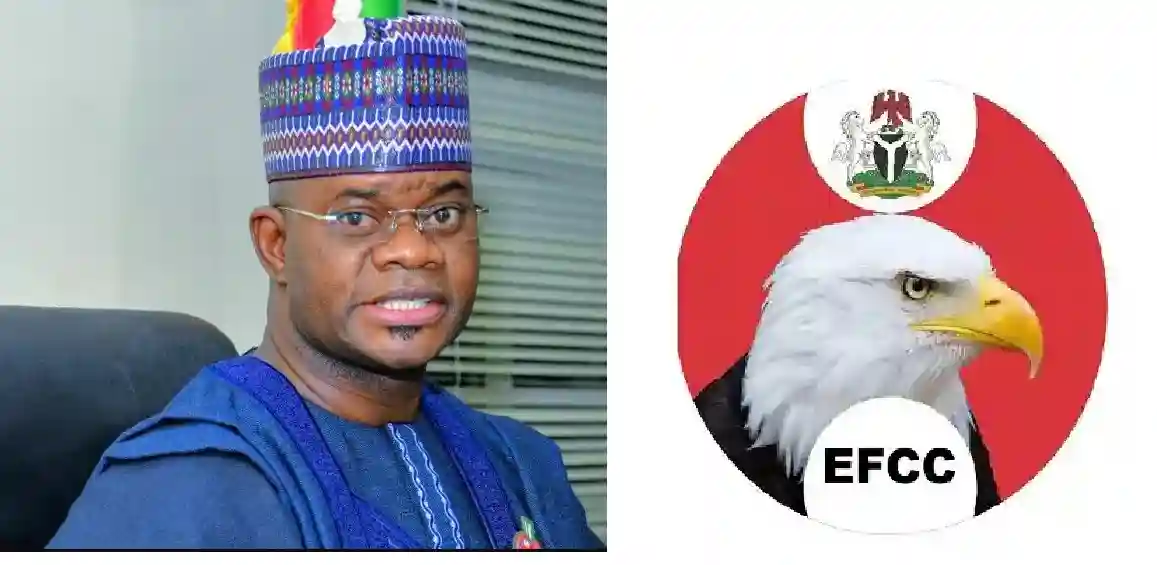
The former Governor of Kogi State, Yahaya Bello, was today arrested by the Economic and Financial Crimes Commission (EFCC) after seven months on the run. His arrest follows an intense investigation into alleged fraud involving a staggering sum of N80 billion, reportedly misappropriated during his time in office.
This dramatic turn of events marks a major chapter in the ongoing efforts of Nigeria’s anti-corruption agencies to bring financial criminals to justice, especially those with political influence.
The Alleged Fraud and the EFCC’s Hunt
Yahaya Bello, who served as Kogi State’s Governor from January 2016 to January 2024, has been a controversial figure in Nigerian politics. His administration, which was marked by both political triumphs and significant criticisms, now faces serious allegations of corruption. According to the EFCC, Bello and several associates were implicated in the embezzlement of N80 billion from the state’s treasury. The funds were reportedly diverted through a combination of fake contracts, inflating costs for infrastructure projects, and siphoning off public funds meant for development projects, among other tactics.
In April 2024, the EFCC declared Yahaya Bello wanted after months of trying to get him to face charges in connection with the fraudulent activities. The investigation found that while he was governor, large sums of public money had been funneled into private accounts, with little accountability. The EFCC, armed with evidence, had intensified efforts to apprehend the former governor, but he managed to evade arrest for months, raising questions about his access to power and influence during the transitional period to his successor.
Political Immunity and the Role of Governor Usman Ododo
One of the most critical factors in Yahaya Bello’s ability to avoid arrest was the political shield provided by his successor, Governor Usman Ododo. Under Nigerian law, sitting governors enjoy immunity from prosecution while in office, a provision designed to allow them to perform their duties without the distraction of legal harassment. However, this immunity does not extend once their tenure concludes, and it is this window of immunity that ex-Governor Bello reportedly exploited.
Governor Ododo, who succeeded Bello in January 2024, had been in office for several months before the EFCC’s investigation began to gain traction. Bello’s supporters have suggested that Ododo’s administration may have been complicit in protecting the former governor from legal consequences, potentially out of loyalty or political calculation. During this period, it was alleged that Bello remained out of sight, leveraging the political influence of his successor to delay the legal proceedings against him.
This period of political protection came to a head in late November 2024 when the EFCC finally located and arrested Yahaya Bello. With Ododo’s immunity no longer providing a shield, the former governor was taken into custody, and the law enforcement agencies now have the opportunity to press charges against him.
The Allegations and Implications
The alleged fraud that Yahaya Bello is accused of has significant implications for the people of Kogi State, as well as for the political landscape of Nigeria. The funds allegedly misappropriated during his tenure were meant for critical development projects in Kogi, including infrastructure, education, and healthcare. If proven guilty, Bello’s actions could have far-reaching effects on the economic well-being of the state, which is one of Nigeria’s poorer regions, heavily reliant on government support for development.
Beyond the local impact, the arrest of Yahaya Bello sends a strong message to politicians and public officials across the country about the importance of accountability. In a nation where corruption remains a persistent issue, the EFCC’s pursuit of powerful figures like Bello represents an effort to curtail the culture of impunity that has plagued Nigerian politics for decades.
For months, the EFCC had been hot on the trail of Yahaya Bello, despite his attempt to evade justice. The commission, which has long been tasked with rooting out corruption and financial crimes in Nigeria, has faced many challenges in recent years. Political influence, complex financial schemes, and the sheer scale of fraud often hinder the agency’s work. Nevertheless, the EFCC’s persistence in this case, and its eventual success in apprehending a high-profile figure like Bello, is a testament to the agency’s determination.
The investigation into Bello’s alleged financial crimes was part of a broader effort by the EFCC to tackle corruption in Nigerian state governments. With several former governors and public officials facing similar investigations, the arrest of Bello is seen as a win for the agency and a potential turning point in the fight against political corruption.
The arrest of Yahaya Bello has sparked mixed reactions across Nigeria. While many citizens, particularly those in Kogi State, have expressed relief and hope that justice will be served, others have raised concerns about the political implications of the arrest. Some supporters of the former governor argue that the charges against him are politically motivated and part of a broader agenda to discredit him and his allies. On the other hand, critics argue that this is long overdue and should serve as a warning to other public officials who believe they are untouchable.
As the case moves through the courts, it remains to be seen how the legal proceedings will unfold. If convicted, Yahaya Bello could face significant penalties, including a lengthy prison sentence and the forfeiture of assets. However, given the political stakes involved, the outcome of this case may have a lasting impact not only on Kogi State but also on Nigeria’s anti-corruption efforts at large.
The arrest of Ex-Governor Yahaya Bello marks a significant moment in Nigeria’s fight against corruption. After seven months of evading justice, his apprehension by the EFCC signals the end of his political protection and the beginning of a legal battle that could redefine his legacy. For Kogi State and the Nigerian public, the case is a reminder of the importance of transparency and accountability in government.
Leave a Reply