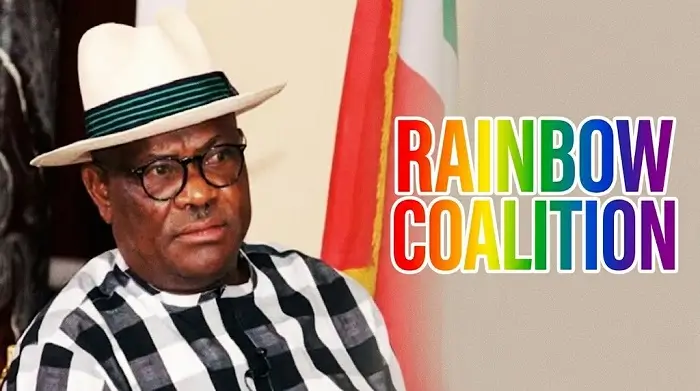
The Rainbow Coalition promoted by FCT Minister Nyesom Wike has emerged as a notable political movement ahead of Nigeria’s 2027 general elections. The coalition is being presented as a multi-party platform for mobilising support for President Bola Tinubu’s re-election. However, its activities have also generated debate over the relationship between the coalition, the APC and the PDP.
How the Rainbow Coalition Emerged
The Rainbow Coalition has been associated with Wike’s political network in Rivers State and has expanded its activities beyond the state. Reports in 2026 showed that efforts were already being made to bring different political interests together under the movement. A reconciliation committee was also established in Rivers State as part of attempts to reunite political actors.
The movement has therefore developed as a cross-party political structure rather than a conventional political party. Its membership and support base are expected to include politicians and supporters from different political backgrounds.
Wike has repeatedly linked the coalition to the 2027 presidential election. His stated objective is to mobilise support for Tinubu, while allowing political parties to pursue their own interests in other elections.
Wike’s Political Structure for 2027
The political arrangement associated with Wike has attracted attention because it operates across existing party boundaries. The minister has maintained that supporting Tinubu does not mean abandoning the PDP or preventing the party from contesting other positions.
In his latest clarification, Wike said he never promised that the PDP would refrain from presenting candidates for governorship, National Assembly and State House of Assembly elections. He also said the Rainbow Coalition was not an arrangement with the APC.
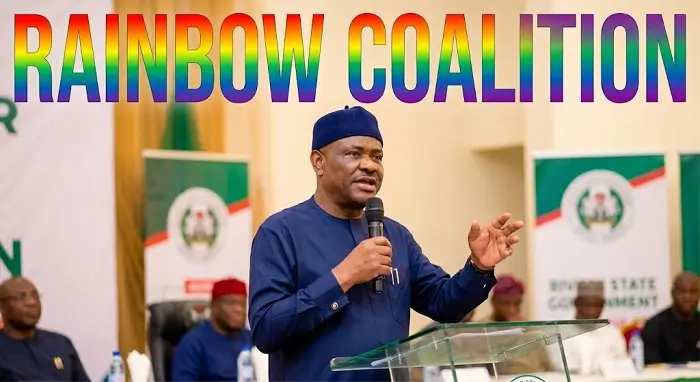
This creates a political structure in which presidential support can be coordinated separately from contests at state and legislative levels. Wike has described the approach as mobilisation across political parties rather than a merger with the APC.
The arrangement has nevertheless created tension with some APC governors. The Progressive Governors Forum has said its members will support APC candidates and will not endorse political arrangements that could weaken the party or its candidates.
Purpose and Mandate Ahead of 2027
The central stated purpose of the Rainbow Coalition is to mobilise support for Tinubu’s re-election in 2027. Wike has said the coalition is focused on the President rather than on controlling the APC as a political party.
Its broader political mandate is being shaped around cross-party mobilisation, grassroots organisation and support for the presidential election. The coalition is also expected to remain involved in political negotiations across states as the election approaches.
Wike has stressed that politics at the state level should be handled locally. His position is that politicians seeking support in their states should resolve their local political disputes rather than attaching every contest to the President’s re-election campaign.
The distinction could become significant as the 2027 campaigns develop. Presidential alliances may not necessarily translate into identical alliances for governorship, Senate, House of Representatives and State House of Assembly contests.
Challenges Facing the Coalition
A major challenge is the disagreement with sections of the APC leadership. The APC Governors Forum has rejected support for alliances that could weaken the party or affect its candidates. This position could limit cooperation between the coalition and APC structures at the state level.
Another challenge is managing competing interests within the PDP. While Wike supports Tinubu’s re-election, the PDP has indicated that it can continue to contest other elections. This creates the possibility of political competition between candidates supported by different interests within the broader alliance environment.
The coalition must also convert political alliances into genuine grassroots support. Wike himself has emphasised the importance of mobilisation at polling units. Organisation, candidate selection, local alliances and voter turnout will therefore remain important factors.
As the 2027 elections approach, the Rainbow Coalition will continue to face the challenge of balancing presidential support with the separate ambitions of political parties and politicians at state and legislative levels.
The centre of Wike’s Rainbow Coalition strategy remains the mobilisation of cross-party support for President Tinubu’s 2027 re-election, while the PDP retains the freedom, according to Wike, to pursue its own candidates in other contests. How successfully these two objectives can coexist will remain a major feature of Nigeria’s political landscape ahead of the 2027 general elections.
Leave a Reply