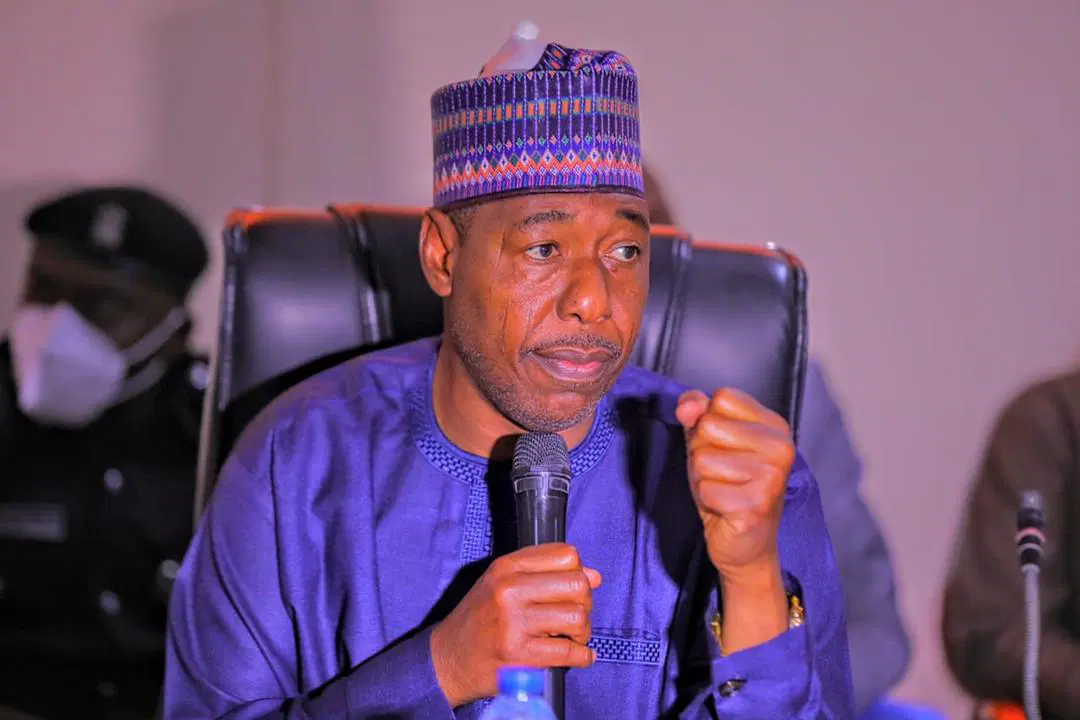
Borno State Governor, Babagana Zulum, has raised concerns about the potential consequences of President Bola Tinubu’s proposed tax reform bills, despite acknowledging the executive power the president holds to push them through.
Governor Zulum cautioned that while the president may have the legal authority to pass the tax bills, the resulting implications could significantly affect millions of Nigerians, especially in the northern region.
The Tax Reform Bill, which has already passed its second reading in the Nigerian Senate, is facing stiff opposition, particularly from Northern elites. Groups such as the Northern Governors Forum, the Northern Elders Forum, the National Economic Council, and notable politicians like Senator Mohammed Ali Ndume have expressed concerns over the bill, claiming that it overlooks regional interests and could worsen economic disparities.
Governor Zulum, while expressing his respect for President Tinubu’s power, emphasized that the tax reform would have disproportionate negative effects on many regions of Nigeria. He explained that while Lagos and Rivers states are likely to benefit from the new tax scheme, the North and other parts of the country could face severe economic losses.
“If the president wants to use his power to pass the tax bill, he may have his way, but it has its consequences on the people,” Zulum stated. His concern stems from the proposed VAT allocation provisions in the bill, which suggests that 60% of VAT tax should be distributed based on derivation—benefiting primarily regions with higher economic output, like Lagos and Rivers.
Zulum further highlighted that the northern region would likely be disadvantaged by the bill, as their economies do not generate the same level of tax revenue as the coastal states. He stated that, after conducting research, his team concluded that the North would lose out under the new VAT allocation system, which could deepen the already existing economic inequalities between regions.
Governor Zulum also called for a pause in the implementation of the tax reforms, stressing the need for further consultations with stakeholders across the country. He pointed out that during the National Economic Council (NEC) meeting, governors had recommended that the federal government take more time to understand the full implications of the bill and engage more thoroughly with regional leaders and economic experts.
“We felt that the VAT provision in the tax law, which clearly stated that VAT allocation should be based on derivation… the proposed bill further stated that 60 percent of the VAT tax will be shared based on derivation. Only Lagos and Rivers states will benefit from this scheme,” Zulum noted.
According to the governor, while he is not an economist, the research conducted by his team showed that the reform would disadvantage regions outside the south-west and south-south. Zulum stressed that if the bill were to pass as currently written, regions like the North-East, North-West, and even parts of the South-East and South-South would suffer significant economic setbacks.
A Plea for Democratic Principles in Tax Reform
Zulum’s objections also reflect a broader call for transparency and inclusivity in the legislative process. “We are in a democracy. We should understand the nitty-gritty of this tax regime,” he said, emphasizing that the tax reform must be shaped by thorough discussions and careful consideration of how it would impact all regions of the country.
The governor concluded that his bone of contention was the potential harm the bill could do to the socio-economic growth of northern Nigeria and other less economically robust regions.
Governor Zulum’s statements underline the ongoing tension between national economic reform and regional interests. While the Tax Reform Bill is seen by some as a necessary step to streamline Nigeria’s tax system and boost revenue generation, others, especially in the north, argue that it risks exacerbating existing inequalities by favoring more economically developed regions.
Governor Zulum’s call for a pause and further consultations serves as a reminder that in a diverse and multi-regional country like Nigeria, any major economic reform must take into account the varied needs and capacities of each region to avoid unintended consequences for millions of citizens.
Leave a Reply