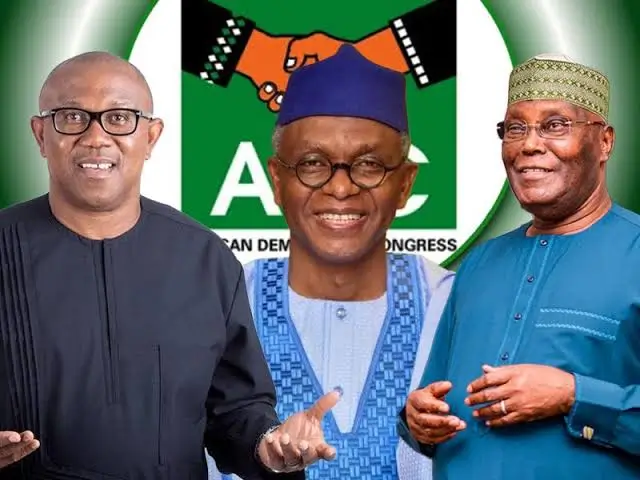
The Impact of the Atiku, Obi, El-Rufai Coalition on Nigeria’s 2027 Presidential Election. Can President Tinubu and the APC Withstand the Challenge?
As Nigeria approaches the 2027 presidential election, the country’s political terrain is undergoing a seismic shift. At the center of this transformation is a powerful and unexpected coalition involving former Vice President Atiku Abubakar, former Anambra State Governor Peter Obi, and former Kaduna State Governor Nasir El-Rufai. These political heavyweights, each with a strong following and distinct ideological backgrounds, have forged an alliance under the African Democratic Congress (ADC) to mount a formidable challenge to President Bola Ahmed Tinubu and the ruling All Progressives Congress (APC).
Table of Contents
Felix Omoko Blog in this post explores the significance of this coalition, its strengths and potential weaknesses, and whether President Tinubu can withstand this rising political wave.
The Making of a Coalition – ADC
On July 2, 2025, a major political announcement reverberated through Nigeria’s political landscape. The African Democratic Congress (ADC), once a relatively minor party, became the platform for a coalition of powerful opposition figures. Atiku Abubakar of the People’s Democratic Party (PDP), Peter Obi of the Labour Party (LP), and Nasir El-Rufai – previously affiliated with the Social Democratic Party (SDP) and APC—announced a strategic alliance to “rescue Nigeria” and prevent the consolidation of a one-party state under Tinubu’s APC. According to David Mark, former Senate President and a key coalition figure, the alliance aims to create a “unified democratic front” and reflect the will of disenfranchised Nigerians seeking credible leadership.
Strengths of the Coalition
The Atiku, Obi, El-Rufai coalition brings together diverse political strengths that could dramatically reshape the 2027 electoral race. First, there is the electoral math. In the 2023 presidential election, Atiku and Obi collectively polled over 13 million votes, compared to Tinubu’s approximately 8 million. If they can successfully unite their voting blocs – Atiku’s Northern support, Obi’s influence in the South-East, and El-Rufai’s grip on the Middle Belt – the coalition may create a nationwide movement.
Finally, the coalition’s leadership carries symbolic and political weight. Atiku and Obi have national campaign experience, while El-Rufai brings strong administrative credentials and strategic thinking. Their alliance – if well-coordinated – could project the kind of leadership and competence many Nigerians now demand.
Secondly, the coalition taps into growing anti-incumbency sentiment. Economic hardship, fueled by the removal of fuel subsidies, a volatile exchange rate, and escalating insecurity, has led many Nigerians to question Tinubu’s governance. These frustrations have created fertile ground for opposition mobilization.
Internal Challenges and Limitations
Despite its promise, the coalition faces serious structural and strategic hurdles. Chief among them is the issue of internal cohesion. While the unity message is compelling, skeptics argue that the alliance is built more on mutual opposition to Tinubu than on shared policy direction. Without a unified manifesto, ideological coherence, or disciplined party machinery, the coalition risks fragmentation.
Another critical weakness is the lack of support from sitting governors. Unlike the APC in 2015, which built its momentum with support from several state governors, the new coalition lacks access to the state-level machinery required for grassroots mobilization and election logistics. Moreover, the coalition is currently financially outmatched. The APC, with access to state resources and wealthier backers, holds a distinct funding advantage that could tilt the balance during the campaign season.
There are also concerns about identity politics and ideological contradictions. While Atiku and Obi are seasoned politicians, their previous clashes and differing political philosophies may cause friction. El-Rufai’s controversial political statements and polarizing personality may also complicate national appeal.
Tinubu and the APC: Counter-Strategies and Incumbency Advantage
President Tinubu and the APC are not taking the threat lightly. The APC has already begun positioning Tinubu as the “grandmaster of coalitions,” with party officials boasting of his ability to attract opposition figures and neutralize dissent. The president’s camp is also working hard to present the new coalition as opportunistic and unstable—composed of leaders with clashing ambitions and inconsistent ideologies.
The APC retains significant institutional leverage. From control of federal agencies and the military to influence over electoral logistics and funding channels, Tinubu’s incumbency provides structural advantages that no opposition coalition can match overnight. The APC is also adept at co-opting opposition figures, and there is a strong possibility that some coalition members may defect before the 2027 election, especially if offered federal appointments or other incentives.
Moreover, if Tinubu’s administration manages to stabilize the economy and improve security conditions by 2026, the current dissatisfaction could diminish, blunting the opposition’s momentum.
A Competitive Contest or a Repeat of 2023?
The Atiku, Obi, El-Rufai coalition represents the most significant challenge to APC dominance since the party’s formation. It channels widespread frustration, draws from a broad national base, and aims to revive the spirit of the 2015 opposition that unseated an incumbent government. Yet, whether this coalition can translate into a unified electoral force remains uncertain.
The success of this alliance will depend on three critical factors: genuine political unity without ego-driven conflict; the development of a well-funded and grassroots-driven campaign structure; and the coalition’s ability to remain resilient under pressure from the APC’s well-oiled political machine.
President Tinubu, while vulnerable to rising public discontent, still holds significant advantages. Unless the opposition can present a compelling alternative – backed by disciplined strategy and effective messaging – the APC may once again outmaneuver a fragmented opposition.
The Nigeria’s 2027 presidential election is poised to be one of the most competitive in its history. The coalition has injected new energy into the political arena, but its real test lies ahead.
Leave a Reply