
The Nigerian education system has recently rolled out a new curriculum for primary and secondary schools, designed to equip students with foundational knowledge, practical skills, and global competencies. The curriculum emphasizes core subjects while allowing flexibility for vocational and elective options.
Primary and Junior Secondary Curriculum
All pupils are expected to study a set of core subjects, which provide a strong foundation in literacy, numeracy, and science, alongside skills for holistic development:
Core Subjects:
- English Studies
- Mathematics
- Nigerian Languages (One Nigerian Language)
- Integrated Science
- Physical & Health Education
- Digital Technologies
- Christian Religious Studies (CRS) – for Christian pupils
- Islamic Studies (IS) – for Muslim pupils
- Nigerian History
- Social and Citizenship Studies
- Cultural & Creative Arts (CCA)
Trade Subjects (Students Choose One):
- Solar Photovoltaic Installation and Maintenance
- Fashion Design and Garment Making
- Livestock Farming
- Beauty and Cosmetology
- Computer Hardware and GSM Repairs
- Horticulture and Crop Production

Other Electives:
- Business Studies
- French (Optional)
- Arabic Language (Optional)
Note: Students must offer a minimum of 12 subjects and can take up to 13 or 14 subjects, depending on electives chosen.
Senior Secondary Curriculum
For senior secondary students, the curriculum is structured to ensure a balance of core academic subjects, trade skills, and elective options.
Core and Compulsory Subjects:
- English Language
- General Mathematics
One Trade Subject
- Citizenship and Heritage Studies
- Digital Technologies
Science Subjects:
- Biology, Chemistry, Physics
- Agriculture
- Further Mathematics
Health and Physical Education:
Physical Education, Health Education, Foods & Nutrition
Humanities:
Nigerian History, Government, Christian Religious Studies, Islamic Studies
- One Nigerian Language, French, Arabic
- Visual Arts, Music, Literature in English
- Home Management, Catering Craft
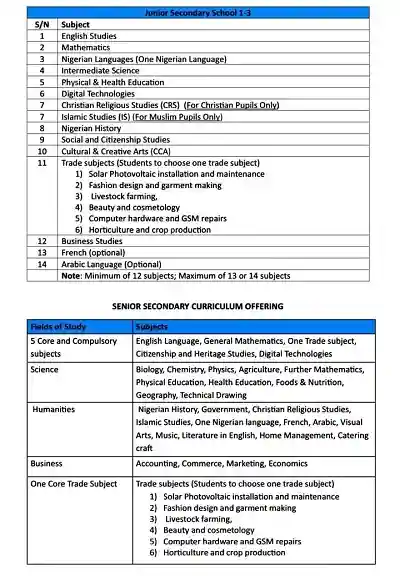
Business Studies:
Accounting, Commerce, Marketing, Economics
Trade Subjects (Students Choose One):
- Solar Photovoltaic Installation and Maintenance
- Fashion Design and Garment Making
- Livestock Farming
- Beauty and Cosmetology
- Computer Hardware and GSM Repairs
- Horticulture and Crop Production
This curriculum ensures that Nigerian students acquire not only academic knowledge but also practical skills that can drive entrepreneurship and employability in the 21st century.
Leave a Reply