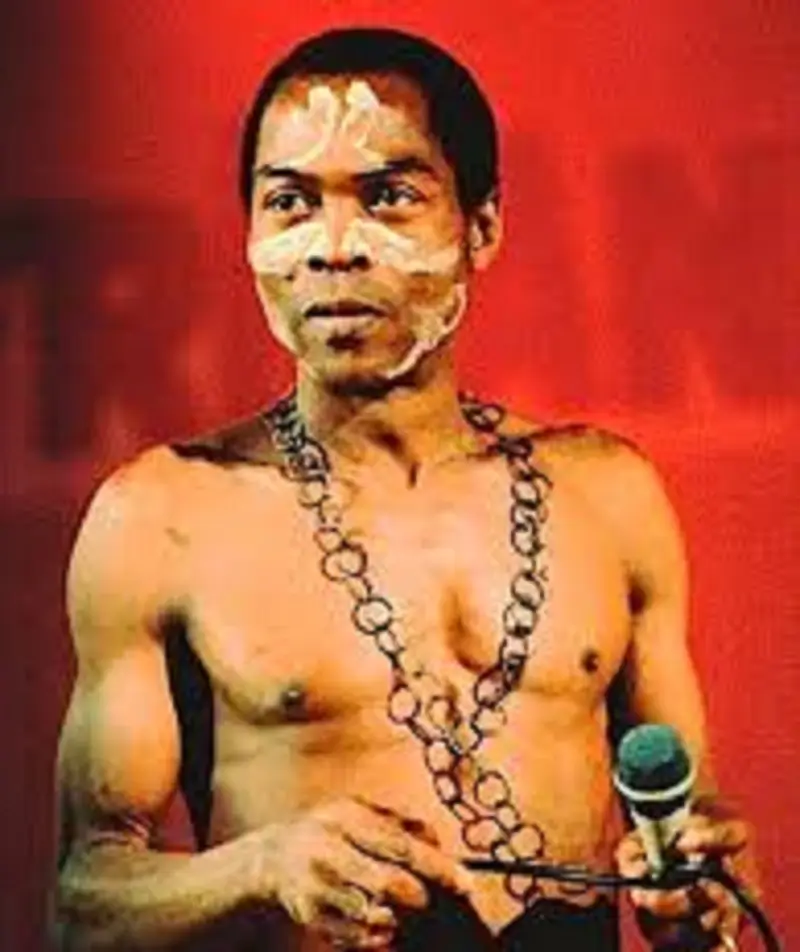
Fela Anikulapo Kuti remains one of Africa’s most influential cultural figures, remembered as a revolutionary musician, political activist, and fearless critic of injustice. Through his creation of Afrobeat, Fela fused music with social commentary, transforming sound into a weapon against oppression.
His life was marked by brilliance, controversy, resistance, and an unwavering commitment to African identity and freedom. Decades after his death, his music and message continue to resonate across generations and borders.
Family Background
Fela was born Olufela Olusegun Oludotun Ransome-Kuti on October 15, 1938, in Abeokuta, Ogun State, Nigeria. He came from a highly educated and politically conscious family. His father, Reverend Israel Oludotun Ransome-Kuti, was a respected Anglican clergyman and school principal.
His mother, Funmilayo Ransome-Kuti, was a prominent women’s rights activist, nationalist, and one of Nigeria’s leading anti-colonial voices. Growing up in such a household exposed Fela early to ideas of resistance, justice, and African self-determination, which later became central themes in his music and activism.
Education and Early Influences
Fela received his early education in Nigeria before traveling to London in the late 1950s to study medicine. However, he soon changed his path and enrolled at Trinity College of Music, where he studied music and trumpet. While in London, he was exposed to jazz, highlife, and Western classical music, which helped shape his musical foundation.
Despite this formal training, Fela’s political consciousness deepened later, particularly after his travels to the United States, where he encountered Black liberation movements that influenced his worldview and artistic direction.
Music Career and the Birth of Afrobeat
Fela’s music career began in earnest in the early 1960s when he formed his first band, Koola Lobitos. Initially blending highlife with jazz, his sound evolved over time into what would become Afrobeat, a genre characterized by complex rhythms, extended instrumental sections, heavy percussion, and socially charged lyrics. Afrobeat was more than music; it was a cultural and political statement.
By the 1970s, Fela had established himself as a powerful voice in Nigeria and beyond. His songs openly criticized military governments, corruption, colonial mentality, and social inequality. Tracks often ran for over ten minutes, allowing him to build musical tension while delivering sharp, confrontational messages. His nightclub, the Afrika Shrine, became a gathering place for music, political discourse, and cultural expression.
Activism, Fame, and Confrontation with Authority
Fela’s fame grew rapidly, but so did his conflicts with the Nigerian state. He declared his communal residence, the Kalakuta Republic, independent from Nigeria, a symbolic act that attracted intense government hostility. His outspoken opposition to military rule led to repeated arrests, harassment, and violent raids. Despite intimidation, Fela remained defiant, using his music and public persona to challenge authority.
Internationally, Fela gained recognition as a revolutionary artist whose work spoke to global struggles against oppression. He toured extensively and influenced musicians worldwide. His adoption of the name Anikulapo, meaning “he who carries death in his pouch,” reflected his belief that he controlled his own destiny and would not be silenced.
Children and Personal Life
Fela Kuti’s personal life was as unconventional as his music. He married 27 women in a single ceremony in 1978, many of whom were dancers and singers in his band. Although he later divorced them, he fathered many children, several of whom followed in his musical footsteps. Notable among them are Femi Kuti and Seun Kuti, both of whom have carried forward the Afrobeat tradition while adding their own modern influences. Through his children, Fela’s musical and ideological legacy continues to evolve.
Final Years and Death
In his later years, Fela’s health declined, but he remained active musically and politically. He continued to release albums and speak out against injustice, even as Nigeria transitioned through different political phases. On August 2, 1997, Fela Anikulapo Kuti died in Lagos at the age of 58. His death marked the end of an era, but it also sparked renewed global interest in his work and philosophy.
Legacy
Fela Kuti’s influence extends far beyond his lifetime. He reshaped African music, inspired political resistance through art, and challenged global perceptions of African creativity. His music remains a powerful reminder that art can be both beautiful and confrontational, entertaining and transformative. Today, Fela is remembered not just as a musician, but as a symbol of courage, cultural pride, and uncompromising truth.
Leave a Reply