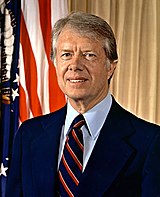
Jimmy Carter remained one of the most respected leaders in the United States. His life was shaped by public service, faith and dedication to peace. His family background, education and political journey were widely recognised. His presidency was closely watched across the United States. His tenure brought notable reforms and difficult challenges.
His place in the List of US President has continued to be discussed because of his leadership at home and humanitarian work after leaving office.
Table of Contents
Family, Birth and Parents
Jimmy Carter was born on 1 October 1924 in Plains, Georgia, United States. He was raised in a farming family. His father was James Earl Carter Sr., who worked as a farmer and businessman. His mother was Lillian Gordy Carter, who served as a registered nurse and was admired for helping people in her community.
He married Rosalynn Smith in 1946. Their marriage lasted for more than seven decades. Four children were raised by the couple. A strong family life was maintained throughout his public career.
His background helped to shape his values. Those values were reflected during his tenure in public office. His name remains prominent in the List of US President because of his simple lifestyle and commitment to service.
Education
Jimmy Carter received his early education in Georgia. He later attended Georgia Southwestern College and the Georgia Institute of Technology before entering the United States Naval Academy.
He graduated from the Naval Academy in 1946. He served as a naval officer for several years. Technical knowledge and discipline were gained during military service. After the death of his father, he returned to Georgia to manage the family farm.
His education prepared him for leadership. His understanding of public service was strengthened. His place in the List of US President was later secured after years of experience in different fields. His tenure in government reflected lessons learned through education and service in the United States.
Political Career
Jimmy Carter entered politics in the early 1960s. He served in the Georgia State Senate before seeking higher office.
His political journey included:
- Election to the Georgia State Senate.
- Election as Governor of Georgia in 1970.
- Campaign for the presidency in 1976.
- Victory in the presidential election.
He became known as a reform-minded politician. Greater honesty in government was promised. Public confidence was encouraged after a period of political uncertainty in the United States.
His political rise earned him a lasting position in the List of US President. His tenure was built on promises of transparency, fairness and respect for democratic values. His political party was the Democratic Party. The party supported many of his domestic and foreign policy goals.
Jimmy Carter Presidency and Vice President
Jimmy Carter became the 39th President of the United States on 20 January 1977. His vice president was Walter Mondale. They served together until 20 January 1981.
During his presidency, attention was given to:
- Energy conservation.
- Human rights.
- Environmental protection.
- International diplomacy.
- Government reforms.
Historic peace efforts were achieved through the Camp David Accords between Egypt and Israel. That agreement was recognised around the world.
His tenure lasted one full presidential term. His party continued to promote social programmes and diplomatic engagement. His administration remains an important chapter in the List of US President because of its focus on peace and international cooperation in the United States.
Major Achievements in Office and Challenges Faced
Several achievements were recorded during Jimmy Carter’s presidency. Many of them continued to influence later administrations.
Major achievements included:
- Successful mediation of the Camp David Peace Accords.
- Expansion of human rights in foreign policy.
- Creation of the Department of Energy.
- Strengthening of environmental protection efforts.
- Support for education and government reform.
Several serious challenges were also faced during his tenure.
They included:
- High inflation.
- Rising unemployment.
- Energy shortages.
- The Iran hostage crisis.
- Public dissatisfaction with the economy.
These issues affected public confidence and contributed to his defeat in the 1980 presidential election.
After leaving office, Jimmy Carter devoted much of his life to humanitarian work. His efforts through the Carter Center and international peace missions earned global respect. He later received the Nobel Peace Prize for promoting peace and human rights.
His story continues to inspire people across the United States. His tenure remains an important period for historians. His party shaped many of his policies despite difficult economic conditions. His achievements and challenges continue to define his place in the List of US President, making Jimmy Carter one of the most remembered American leaders.
Leave a Reply