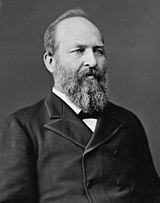
James A. Garfield was the 20th President of the United States, serving for only a few months in 1881 before his life was cut short by an assassin’s bullet. Born into modest circumstances, James A. Garfield rose through education, the ministry and politics to reach the White House. His presidency was marked by reform efforts, political disputes and challenges that were inherited from a deeply divided system. Although his time in office was brief, James A. Garfield became associated with civil service reform and the struggle against political patronage. His story remains an important chapter in the history of the US President and the development of the United States.
James A. Garfield: Education and Family
James A. Garfield was born on 19 November 1831 in Orange Township, Ohio. He was raised in a financially modest family after his father died when he was still a child. Despite these difficulties, education was strongly valued.
He attended the Geauga Seminary and later studied at the Western Reserve Eclectic Institute, now known as Hiram College. His academic abilities were developed further at Williams College in Massachusetts, where he graduated in 1854.
After completing his studies, James A. Garfield became an educator and later served as a principal. He was also trained in law and became a minister in the Disciples of Christ tradition.
His family life was centred on Lucretia Rudolph, whom he married in 1858. They had five children who survived infancy. His wife later played an important role in preserving his legacy after his death.
Political Career and Rise to the White House
James A. Garfield entered politics through the Republican Party and was elected to the Ohio Senate in 1859. During the American Civil War, he served as a Union officer before entering the US House of Representatives in 1863.
His political career in Congress lasted many years, during which he became recognised for his speaking ability, financial knowledge and support for reform. His influence eventually placed him among the leading Republican politicians in the United States.
In 1880, James A. Garfield was unexpectedly nominated as the Republican presidential candidate after a divided convention. He defeated Democratic candidate Winfield Scott Hancock in the general election.
His victory brought him to the White House at a time when political patronage was a major source of controversy. As US President, he attempted to establish greater independence in government appointments and reduce the influence of political factions.
Achievement and Reform Efforts
The presidency of James A. Garfield lasted only from 4 March to 19 September 1881, although he remained incapacitated for much of that period after being shot.
Several important goals were pursued during his short administration:
- Civil service reform was supported to reduce political patronage.
- Greater administrative efficiency was encouraged.
- Educational opportunities for African Americans were advocated.
- The independence of presidential appointments was defended.
The White House was consequently drawn into a major dispute with Republican faction leader Roscoe Conkling. Garfield’s resistance to patronage demonstrated his willingness to challenge established political practices.
His administration also sought to strengthen the authority of the presidency. Although his programme was interrupted, James A. Garfield’s reform position contributed to the wider political movement that eventually produced federal civil service reform.
Challenges Faced in Office and Cause of Death
The presidency of James A. Garfield was severely affected by political divisions and an assassination attempt. On 2 July 1881, Charles J. Guiteau shot him at a railway station in Washington, D.C.
Garfield initially survived the attack, but his condition deteriorated over the following weeks. Medical treatment at the time was limited, and repeated probing of the wound was carried out without modern sterile practices. Infection eventually developed.
James A. Garfield died on 19 September 1881, aged 49. His cause of death was complications from the gunshot wound, including severe infection and internal damage.
The assassination shocked the United States and generated renewed support for changes to the federal appointment system. In the aftermath, the political pressure for reform became stronger.
James A. Garfield therefore remains remembered not simply for the brevity of his presidency, but for the reform principles he attempted to defend. The White House, the US President and the political institutions of the United States were shaped by the controversies surrounding his administration. His education, family background, political career, achievements, challenges faced in office and tragic cause of death continue to make James A. Garfield an important figure in the history of the United States.
Leave a Reply