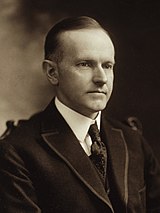
Calvin Coolidge was the 30th President of the United States. Born in Vermont, he rose through local politics before reaching the White House. His quiet manner became his political trademark. As US President, he promoted limited government, business confidence and fiscal restraint. His years in office reflected economic growth in the United States of America, although serious social and economic problems remained.
Family & Education
He was born on 4 July 1872 in Plymouth Notch, Vermont. His father, John Coolidge Sr., was a farmer, storekeeper and local public official. His mother, Victoria Josephine Moor, died when he was young.
He attended Amherst College in Massachusetts and graduated in 1895. He later studied law and entered practice in Northampton. His education helped shape his disciplined approach to public affairs. The future US President developed a reputation for careful speech and firm judgement.
He married Grace Goodhue in 1905. They had two sons, John and Calvin Jr. Family life remained important to him despite the demands of public office.
Calvin Coolidge Administration
He entered the White House after President Warren G. Harding died in August 1923. Coolidge was sworn in by his father, a Vermont notary public, at the family home. He was elected in his own right in 1924.
The administration emphasised tax reduction, balanced budgets and limited federal intervention. Treasury Secretary Andrew Mellon supported major tax cuts. The government also sought to reduce national debt. The administration became associated with a restrained style of leadership.
During his presidency, the United States of America experienced strong industrial expansion. Consumer goods became more widely available. Radio, cars and household appliances grew in popularity. Yet agricultural difficulties and unequal prosperity persisted.
Political Career
Before becoming US President, he built his career in Massachusetts politics. He served as a city councillor and later became mayor of Northampton. He was elected to the Massachusetts House of Representatives and then became state senator.
His rise accelerated when he became lieutenant governor and, in 1919, governor of Massachusetts. He gained national attention during the Boston Police Strike. Coolidge opposed the striking police officers and declared that public safety had to be protected.
The episode strengthened his conservative image. It also helped him secure the vice-presidential nomination in 1920. As vice-president, he worked within the administration before succeeding Harding. His political career was therefore built on local experience, state leadership and national visibility.
Successor in Office
Calvin Coolidge chose not to seek another presidential term after winning the 1924 election. He announced his decision in 1927 through a statement. His successor was Herbert Hoover, who had served as Secretary of Commerce.
Hoover won the 1928 election and entered office in March 1929. The transition occurred before the Wall Street Crash later that year. Hoover inherited an economy that still appeared prosperous, but weaknesses were already present.
The United States of America soon entered the Great Depression. The economic collapse transformed public views of government. Policies associated with the previous decade were later debated as historians assessed the causes of the crisis.
Legacy
Calvin Coolidge left the White House in March 1929 and returned to Massachusetts. He wrote articles and a memoir. He died in January 1933.
The US President remains a significant figure in American political history. Supporters praise his commitment to limited government, lower taxes and fiscal discipline. Critics argue that his administration did not adequately address inequality, agricultural distress and financial risks.
The White House during his presidency symbolised a preference for restraint. The United States of America was experiencing modernisation, but its prosperity was uneven. His record therefore remains contested.
Calvin Coolidge is remembered for a presidency centred on economy, limited government and confidence in private enterprise. The White House under his leadership reflected those priorities. The US President became a symbol of conservative governance. In the United States of America, his administration continues to be studied for both its economic achievements and its limitations.
Leave a Reply