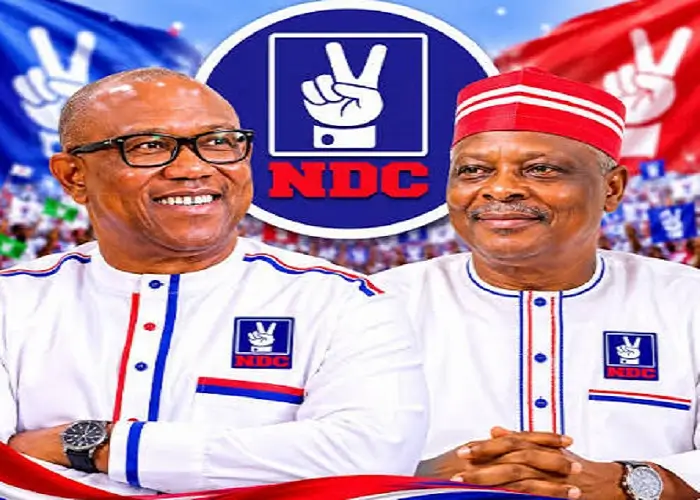
The Peter Obi/Kwankwaso Mandate is gaining momentum as the Nigeria Democratic Congress (NDC) intensifies preparations for the 2027 General Elections. With Peter Obi as presidential candidate and Rabiu Kwankwaso as his running mate, the NDC is building a broader opposition platform aimed at challenging the ruling APC. The campaign is increasingly being organised around national unity, economic recovery, grassroots mobilisation and a coordinated strategy designed to turn growing public support into votes on election day.
Peter Obi/Kwankwaso Mandate Takes Shape
The Peter Obi/Kwankwaso Mandate received a major boost after Obi and Kwankwaso formally joined the NDC and later secured the party’s presidential ticket. Obi was unveiled as the presidential candidate, while Kwankwaso was selected as his running mate.
The arrangement has brought together two influential political movements with significant followings in different parts of Nigeria. Obi has continued to attract strong support among younger voters and professionals, while Kwankwaso retains an established political base, particularly in Kano and parts of northern Nigeria.
The combination is therefore being presented as a means of expanding the opposition’s geographical reach. Rather than relying on one political bloc, the NDC is seeking to build a coalition that can compete across regions and voting demographics.
NDC Campaign Enters Strategic Phase
The NDC campaign has moved beyond the formation of its presidential ticket. Consultations have been intensified among Obi, Kwankwaso and senior party leaders as preparations continue for the nationwide campaign structure. Recent meetings involving the party leadership have focused on strengthening coordination and finalising arrangements for the campaign council.
The approach appears to be centred on disciplined organisation. Grassroots structures are expected to be expanded, while supporters are being encouraged to remain united. The campaign is also expected to rely heavily on digital mobilisation, town-hall engagements, community outreach and direct communication with voters.
For the 2027 General Elections, the challenge will be to transform online enthusiasm and political gatherings into a properly organised voting operation. The NDC must therefore establish ward-level structures, recruit credible agents and maintain strong communication with supporters.
Supporters Continue to Grow
Support for the Obi-Kwankwaso Mandate is being driven by the desire for political change among sections of the electorate. The alliance has also provided an opportunity for supporters of the two politicians to operate under one platform.
The growth of the NDC has been reinforced by political defections and the movement of opposition figures into the party. Several lawmakers previously associated with the ADC moved to the NDC after Obi and Kwankwaso joined the party.
However, growing support alone will not determine the outcome of the 2027 General Elections. A successful presidential campaign requires votes across a broad national spread. The NDC will consequently have to convert enthusiasm into voter registration, turnout and effective election-day organisation.
Strategy to Challenge APC
The central objective of the NDC strategy is to build a sufficiently broad coalition to challenge the APC nationwide. The party is expected to focus on economic hardship, unemployment, insecurity, production, investment and human capital development.
At the launch of his presidential campaign, Obi presented an economic programme focused on moving Nigeria from consumption towards production, with greater emphasis on domestic industry, investment and enterprise.
The strategy is also being strengthened by the political partnership between Obi and Kwankwaso. Kwankwaso has said the two leaders entered a written arrangement under which Obi would serve a single four-year term if elected, with the presidency expected to return to the North in 2031.
Such an arrangement is being positioned as part of the coalition’s effort to address regional concerns and maintain political balance. For the NDC, this could become an important argument as it seeks to persuade voters beyond its traditional support bases.
2027 General Elections Will Test the Mandate
The 2027 General Elections will provide the decisive test for the Peter Obi/Kwankwaso Mandate. INEC has fixed 16 January 2027 for the Presidential and National Assembly elections, while the Governorship and State Houses of Assembly elections are scheduled for 20 February 2027.
The APC remains the ruling party and will enter the contest with the advantages that come with incumbency. The NDC must therefore maintain internal unity, strengthen its national structures and convince undecided voters that its proposed alternative can deliver effective governance.
The Mandate will ultimately depend on organisation as much as popularity. If the NDC can unite its supporters, expand its grassroots network and sustain its campaign message across Nigeria, the Obi-Kwankwaso ticket could become a significant challenger to the APC in the 2027 General Elections.
The 2027 General Elections will therefore be a major test of whether the growing Peter Obi/Kwankwaso Mandate can be transformed into a nationwide electoral force. With the NDC working to consolidate supporters, coordinate its campaign machinery and challenge the APC on economic and governance issues, the opposition ticket is positioning itself for a competitive presidential contest on 20 February 2027.
Leave a Reply