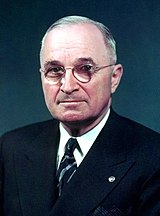
Harry S. Truman remains one of the most consequential US Presidents in the modern History of America, having led the United States of America through the final months of the Second World War and the difficult opening years of the Cold War. Born in Missouri, he entered national politics after years of local public service and became president following Franklin D. Roosevelt’s death in 1945. His decisions shaped America and left a lasting mark on the History of America and the record of presidential leadership.
Harry S. Truman’s Family Background
Harry S. Truman was born on 8 May 1884 in Lamar, Missouri, to John Anderson Truman and Martha Ellen Young Truman. The family later moved to Independence. In 1919, he married Elizabeth “Bess” Wallace. They had one child, Mary Margaret Truman, who became an author and biographer.
His modest origins are significant because his career showed that national leadership could emerge from outside wealthy political families. His family background is also frequently considered when the lives of US Presidents are examined, adding context to presidential history.
Education and Early Development
Truman attended Independence High School and graduated in 1901. He studied at Spalding’s Commercial College in Kansas City but did not complete a university degree. He later attended the Kansas City Law School, now associated with the University of Missouri–Kansas City, without graduating.
His education was supplemented by extensive reading and practical experience in farming, business and public administration. This path was distinctive. It prepared him for national responsibility.
Political Career and Rise
Before entering national politics, Truman worked in farming and business and served as a county judge in Jackson County, Missouri. He was elected to the US Senate in 1934. He chaired a Senate committee investigating defence spending, exposing waste and inefficiency.
In 1944, he was chosen as Roosevelt’s running mate and became vice-president in January 1945. Roosevelt died on 12 April 1945, and Truman was sworn in as president. His sudden rise became an important political turning point.
Presidency Tenure: 1945–1953
Harry S. Truman served as president from 12 April 1945 to 20 January 1953. He inherited the final stage of the war and faced major international decisions. The atomic bombs were dropped on Hiroshima and Nagasaki in August 1945, followed by Japan’s surrender.
After the war, the Truman administration pursued policies aimed at containing Soviet expansion. The Truman Doctrine was announced in 1947, while the Marshall Plan supported recovery. NATO was established in 1949, strengthening the Western alliance. These actions changed the United States of America.
Achievements and Challenges in Office
Among Harry S. Truman’s major achievements were the Marshall Plan, the Truman Doctrine and support for NATO. Israel was recognised in 1948, and civil rights were promoted. Executive Order 9981, issued that year, directed the desegregation of the US armed forces.
The Fair Deal was proposed to expand welfare, housing, education and civil rights. However, significant challenges were encountered. The Korean War began in 1950, causing heavy casualties and political controversy. Relations with the Soviet Union deteriorated, while fears of communism intensified at home.
Truman also faced congressional opposition, labour disputes and criticism over foreign policy. His dismissal of General Douglas MacArthur during the Korean War became highly controversial. Despite opposition, he won the 1948 election against Thomas E. Dewey.
The legacy of Harry S. Truman remains central to understanding US Presidents, History of America and the United States of America. His presidency was defined by war, reconstruction, civil rights and the emergence of the Cold War. Harry S. Truman demonstrated how presidential decisions could reshape domestic policy and international relations. His record continues to represent a defining period in the History of America, the development of US Presidents and the changing role of the United States of America.
His record remains relevant because US Presidents are judged by decisions made under pressure. The History of America is repeatedly shaped by such choices, while the United States of America continues to reflect institutions strengthened during his era.
Leave a Reply