Rutherford B. Hayes was the 19th President of the United States of America, serving from 1877 to 1881 during one of the most politically difficult periods in American history. His presidency was shaped by the disputed election of 1876, the withdrawal of federal troops from the South and efforts to reform government administration. Among the US Presidents, Rutherford B. Hayes is particularly remembered for his contested path to the White House and his attempt to restore public confidence in government. His career remains an important subject in the History of America and in studies of the United States of America.
Family Background
Rutherford B. Hayes was born on 4 October 1822 in Delaware, Ohio. He was the son of Rutherford Hayes and Sophia Birchard Hayes. His father, who operated a small store, died before his birth, while his mother played an important role in raising the family.
Rutherford B. Hayes later married Lucy Webb Hayes in 1852. The couple had eight children, although one child died in infancy. Lucy became a prominent First Lady and was widely known for her interest in education, religion and social causes.
The family background of Rutherford B. Hayes was relatively modest, but strong educational values were encouraged. His upbringing helped shape the disciplined approach that was later displayed during his political career.
Education and Early Development
Rutherford B. Hayes received his early education in Ohio before attending Kenyon College, where he graduated as valedictorian in 1842. His academic performance was followed by legal studies at Harvard Law School.
After completing his legal education, he returned to Ohio and established a law practice in Cincinnati. His professional reputation was gradually built, while his interest in public affairs was also increased.
The educational background of Rutherford B. Hayes was reflected in his measured political style. Among US Presidents, he was regarded as an intellectually accomplished leader whose legal training influenced his approach to public administration and constitutional issues.
Political Career
Rutherford B. Hayes entered politics through the Republican Party and became increasingly involved in Ohio public affairs. During the American Civil War, he served in the Union Army and was wounded several times. His military record contributed to his political reputation.
After the war, he served in the US House of Representatives and later became Governor of Ohio. His political career was strengthened by his reputation for integrity and administrative competence.
His rise occurred during a period when the United States of America was struggling with the consequences of the Civil War and Reconstruction. In the History of America, this period has been recognised as one of intense political conflict.
Presidency Tenure
Rutherford B. Hayes became president after the highly disputed election of 1876. The election results in several states were contested, and an Electoral Commission was established to resolve the dispute. Hayes eventually received the necessary electoral votes and was inaugurated on 4 March 1877.
His presidency was marked by an effort to reduce political divisions. Federal troops were withdrawn from the remaining Reconstruction governments in the South, effectively bringing the Reconstruction era to an end.
During his term, civil service reform was strongly promoted. Hayes opposed the widespread patronage system and supported competitive examinations for government appointments.
His administration also faced tensions with Congress and a major national railway strike in 1877. The response to the strike became one of the most controversial aspects of his presidency.
Achievements and Challenges in Office
Several policies associated with Rutherford B. Hayes continued to influence American government. His administration promoted civil service reform, opposed political corruption and encouraged merit-based appointments.
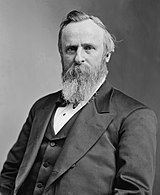
Key areas associated with his administration included:
- Civil service reform and competitive appointments.
- Opposition to excessive political patronage.
- Support for a stronger federal administration.
- Efforts to restore financial and political stability.
- Promotion of educational opportunities, particularly for African Americans.
However, serious challenges were faced. The end of Reconstruction left African Americans in the South increasingly vulnerable to discriminatory laws and political restrictions. The Great Railroad Strike of 1877 also created serious social and economic tensions.
The legacy of Rutherford B. Hayes therefore remains mixed. In the History of America, his presidency is often examined through both reform achievements and the consequences of ending federal Reconstruction enforcement. His administration occupies a distinctive position among US Presidents because its legitimacy was questioned from the beginning.
The story of the United States of America cannot be fully understood without examining the difficult political choices made during the late nineteenth century. Rutherford B. Hayes remains central to that story because his presidency reflected the tensions between electoral legitimacy, civil service reform, Reconstruction and national unity. His place among US Presidents continues to be studied as an important chapter in the History of America, while the experience of his administration demonstrates how decisions made in the United States of America can produce consequences that extend far beyond a single presidential term.
Leave a Reply