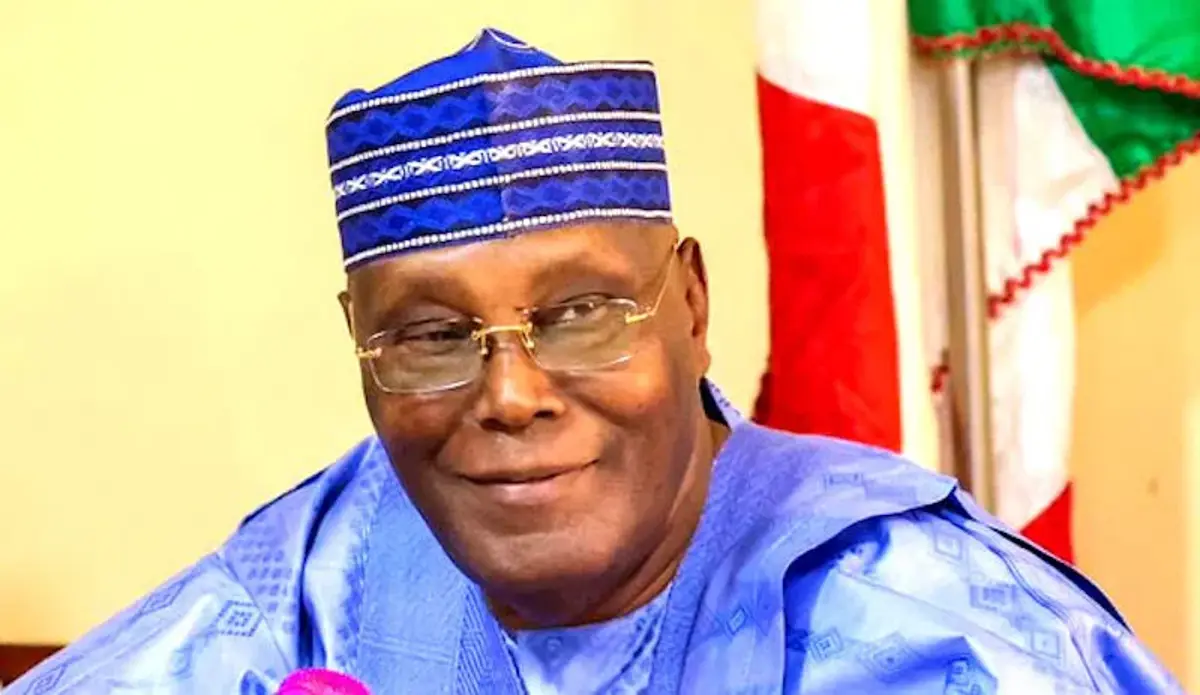
Atiku Abubakar GCON is a Nigerian politician, businessman, philanthropist and presidential candidate of the People’s Democratic Party in 2019 and ahead of the 2023 General election.
He served as the 11th vice-president of Nigeria from 1999 to 2007 under the presidency of Olusegun Obasanjo.
In 1998, he was elected Governor of Adamawa State. While still Governor-Elect, he was selected by then-presidential candidate Olusegun Obasanjo as his running mate. The duo went on to win elections in February 1999, and Abubakar was sworn-in as Nigeria’s second democratically elected vice president on 29 May, 1999.
Family and Origin
Atiku Abubakar was born on 25 November 1946 to a Fulani trader and farmer Garba Abubakar, and his second wife, Aisha Kande, in Jada village of Adamawa State. He was named after his paternal grandfather Atiku Abdulqadir and became the only child of his parents when his only sister died at infancy. In 1957, his father died by drowning while crossing a river to Toungo, a neighbouring village to Jada.
After completed his primary school education in 1960, he was admitted into Adamawa Provincial Secondary School in the same year, alongside 59 other students.
He graduated from secondary school in 1965 after he made grade three in the West African Senior School Certificate Examination. Abubakar then proceeded to attend Nigerian Police College, Kaduna. He left the college for a position as a tax official in the Regional Ministry of Finance.
Later he received admission to study at the School of Hygiene, Kano in 1966. In 1967, he graduated with a diploma.
That same year, Atiku Abubakar was admitted for a Law Diploma at Ahmadu Bello University on a scholarship. He graduated in 1969 and was employed by Nigeria Customs Service that same year.
Abubakar has four wives and is the father to 28 children.
While at Idi-Iroko, Abubakar met nineteen-year-old Titilayo Albert, who he secretly married in December 1971, in Lagos, because her family was initially opposed to the union.
On 26 October 1972, Titilayo delivered a baby girl they named Fatima. She later gave birth to Adamu, Halima and Aminu.
In January 1979, he married Ladi Yakubu as his second wife. “I wanted to expand the Abubakar family. I felt extremely lonely as a child. I had no brother and no sister. I did not want my children to be as lonely as I was.
This is why I married more than one wife. My wives are my sisters, my friends, and my advisers and they complement one another,” Abubakar has said. He has six children with Ladi: Abba, Atiku, Zainab, Ummi-Hauwa, Maryam and Rukaiyatu.
In 1983 he married his third wife, Princess Rukaiyatu, daughter of the late Lamido of Adamawa, Aliyu Musdafa. She gave birth to Aisha, Hadiza, Aliyu (named after her late father), Asmau, Mustafa, Laila and Abdulsalam. His fourth wife, Fatima Shettima, followed in 1986.
Fatima gave birth to her first child Amina (Meena), Mohammed and two sets of twins Ahmed and Shehu, Zainab and Aisha then her last daughter Hafsat.
Abubakar later divorced Ladi, allowing him to marry, as his fourth wife (the maximum permitted him as a Muslim), Jennifer Iwenjiora Douglas.
Education
His father was opposed to the idea of Western education and tried to keep Atiku Abubakar out of the traditional school system. When the government discovered that Abubakar was not attending mandatory schooling, his father spent a few days in jail until Aisha Kande’s mother paid the fine. At the age of eight, Abubakar enrolled in the Jada Primary School, Adamawa.
In 1960, he was admitted to Adamawa Provincial Secondary School in Yola where he did well in English Language and Literature, struggled with Physics and Chemistry and Mathematics. He graduated with a Grade Three WASSCE/GCE Certificate in 1965.
Following secondary school, Abubakar studied a short while at the Nigeria Police College in Kaduna. He left the College when he was unable to present an O-Level Mathematics result. He worked briefly as a Tax Officer in the regional Ministry of Finance, from where he gained admission to the school of Hygiene in Kano in 1966. He graduated with a Diploma in 1967, having served as Interim Student Union President at the school.
In 1967 he enrolled for a Law Diploma at the Ahmadu Bello University Institute of Administration, on a scholarship from the regional government. After graduation in 1969, during the Nigerian Civil War, he was employed by the Nigeria Customs Service.
Business Opportunities
Abubakar started out in the real estate business during his early days as a Customs Officer. In 1974 he applied for and received a 31,000 naira loan to build his first house in Yola, which he put up for rent.
From proceeds of the rent, he purchased another plot and built a second house. He continued this way, building a sizeable portfolio of property in Yola.
In 1981 he moved into agriculture, acquiring 2,500 hectares of land near Yola to start a maize and cotton farm. The business fell on hard times and closed in 1986. “My first foray into agriculture, in the 1980s, ended in failure,” he wrote in an April 2014 blog.[10] He then ventured into trading, buying and selling truckloads of rice, flour and sugar.
Abubakar worked in the Nigeria Customs Service for twenty years, rising to become the Deputy Director, as the second highest position in the Service was then known. He retired in April 1989 and took up full-time business and politics.
He ran for the office of governor in the Gongola State (now Adamawa and Taraba States) in 1991, and for the Presidency in 1993, placing third after MKO Abiola and Babagana Kingibe in the Social Democratic Party (SDP) primaries.
Abubakar’s most important business move came while he was a Customs Officer at the Apapa Ports. Gabrielle Volpi, an Italian businessman in Nigeria, invited him to set up Nigeria Container Services (NICOTES), a logistics company operating within the Ports. NICOTES would go on to provide immense wealth to Abubakar.
Conflict of interest accusations has since trailed him on account of his involvement in business while a civil servant, who exercised supervisory authority.
On his part, Abubakar has defended the decision, saying his involvement was limited to the ownership of shares (which government rules permitted), and that he was not involved in the day-to-day running of the business. NICOTES would later be rebranded INTELS, and go on to feature prominently in accusations of money laundering levelled against Abubakar by the U.S. government during his Vice Presidency.
Abubakar’s business empire also includes Adama Beverages Limited, a beverage manufacturing plant in Yola, as well as an animal feed factory.
Political Profile
Abubakar’s first foray into politics was in the early 1980s, when he worked behind-the-scenes on the governorship campaign of Bamanga Tukur, who at that time was managing director of the Nigeria Ports Authority. He canvassed for votes on behalf of Tukur, and also donated to the campaign.
Towards the end of his Customs career, he met Shehu Musa Yar’Adua, who had been second-in-command of the military government that ruled Nigeria between 1976 and 1979. Abubakar was drawn by Yar’Adua into the political meetings that were now happening regularly in Yar’Adua’s Lagos home.
In 1989 Abubakar was elected a National Vice-Chairman of the Peoples Front of Nigeria, the political association led by Yar’Adua, to participate in the transition programme initiated by Head of State Ibrahim Babangida. The Peoples Front of Nigeria included politicians such as Umaru Musa Yar’Adua, Babalola Borishade, Bola Tinubu, Abdullahi Aliyu Sumaila, Rabiu Kwankwaso, Dapo Sarumi and Sabo Bakin Zuwo.
Abubakar won a seat to represent his constituency at the 1989 Constituent Assembly, set up to decide a new constitution for Nigeria. The People’s Front was eventually denied registration by the government (none of the groups that applied was registered), and found a place within the Social Democratic Party, one of the two parties decreed into existence by the regime.
First gubernatorial run
On 1 September 1990, Abubakar announced his Gongola State gubernatorial bid. A year later, before the elections could hold, Gongola State was broken up into two – Adamawa and Taraba States – by the Federal Government. Abubakar fell into the new Adamawa State. After the contest he won the SDP Primaries in November 1991, but was soon disqualified by the government from contesting the elections.
First presidential run
In 1992 Abubakar launched a bid for the presidency of Nigeria on the platform of the Social Democratic Party. He was unsuccessful, coming third in the convention primaries, losing to MKO Abiola and runner up Babagana Kingibe.
Second gubernatorial run
In 1998 Abubakar launched a bid for the governorship of Adamawa State on the platform of the People’s Democratic Party. He won the December 1998 elections, but before he could be sworn in he accepted a position as the running mate to the People’s Democratic Party’s presidential candidate, former Head of State Olusegun Obasanjo.
Vice-Presidency
Seal of the Vice-President
Abubakar was sworn in as Vice-President of Nigeria on 29 May 1999. He presided over the National Council on Privatization, overseeing the sale of hundreds of loss-making and poorly managed public enterprises.
In 1999 he, alongside South African Deputy President Jacob Zuma, launched the South Africa Nigeria Binational Commission.
In 2006, Abubakar was involved in a bitter public battle with his boss, President Olusegun Obasanjo, ostensibly arising from the latter’s bid to amend certain provisions of the constitution to take another shot at the presidency (for the third consecutive time).
The debate and acrimony generated by the failed constitutional amendment momentarily caused a rift in the People’s Democratic Party. The Nigerian National Assembly eventually voted against any amendments allowing Obasanjo to run for another term.
The Abubakar-Obasanjo face-off damaged the personal relationship between both men.
Second presidential run
On 25 November 2006 Abubakar announced that he would run for president. On 20 December 2006, he was chosen as the presidential candidate of the Action Congress (AC).
On 14 March 2007, the Independent National Electoral Commission (INEC) released the final list of 24 aspirants for 21 April presidential election. Abubakar’s name was missing from the ballot.
INEC issued a statement stating that Abubakar’s name was missing because he was on a list of persons indicted for corruption by a panel set up by the government. Abubakar headed to the courts on 16 March to have his disqualification overturned.
The Supreme Court unanimously ruled on 16 April that INEC had no power to disqualify candidates.
The ruling allowed Abubakar to contest the election, although there were concerns that it might not be possible to provide ballots with Abubakar’s name by 21 April, the date of the election. On 17 April, a spokesman for INEC said that Abubakar would be on the ballot.
According to official results, Abubakar took third place, behind PDP candidate Umaru Yar’Adua and ANPP candidate Muhammadu Buhari, with approximately 7% of the vote (2.6 million votes). Abubakar rejected the election results and called for its cancellation, describing it as Nigeria’s “worst election ever.”
He stated that he would not attend Umaru Yar’Adua’s inauguration on 29 May due to his view that the election was not credible, saying that he did not want to “dignify such a hollow ritual with my presence”.
Post Vice-Presidency
Third presidential run
Following the 2007 elections, Abubakar returned to the People’s Democratic Party. In October 2010 he announced his intention to contest for the Presidency. On 22 November, a Committee of Northern Elders selected him as the Northern Consensus Candidate, over former Military President Ibrahim Babangida, former National Security Adviser Aliyu Gusau and Governor Bukola Saraki of Kwara State.
In January 2011, Abubakar contested for the Presidential ticket of his party alongside President Jonathan and Sarah Jubril, and lost the primary, garnering 805 votes to President Jonathan’s 2736.
2019 General Elections: He was the presidential candidate of the Peoples Democratic Party, PDP in 2019 Presidential Election where he lost to Buhari of APC.
All Progressives Congress
On 2 February 2014, Abubakar left the Peoples Democratic Party to the join All Progressives Congress. with the intent of contesting the Nigerian presidency in 2015 on the party’s platform.
On Friday, 24 November 2017, Abubakar announced his exit from the All Progressives Congress (APC), a party he helped to form.
Atiku’s Returns to PDP
On 3 December 2017, via a Facebook Live broadcast, Abubakar announced his return to the Peoples Democratic Party (PDP). The announcement followed consultations the former Vice President had with party leaders and stakeholders from across the country. He said he decided to ‘return home’ to the PDP now that the issues which made him leave the party had been resolved.
Fourth presidential run
Abubakar declared his candidacy for the presidential nomination of the PDP mid 2018 and won the nomination at its convention on 7 October. He defeated 11 other contestants and got 1,532 votes, 839 more than the runner-up, the Governor of Sokoto State Aminu Tambuwal.
Atiku Abubakar continued his campaign rally in Kogi State as he promised to complete abandoned projects in the state.
On 30 January, he participated in the town hall meeting tagged #NGTheCandidate. And in the meeting, he declared that he will grant amnesty to looters and he vowed to privatize 90% of NNPC, Nigeria’s primary source of income. Atiku took his campaigns to Katsina, visit Emir of Daura on 7 February 2019.
On February 27, 2019, Atiku lost the presidential race to President Buhari. He is willing to contest the election in court describing the election as “worst in Nigeria’s democratic history.”
Atiku’s Philanthropy Movement
American University of Nigeria (AUN) is the first American-style university to be established in Sub-Saharan Africa. It was founded in Yola, the capital of Adamawa State as American University of Nigeria (AUN) by Abubakar in 2005. He has said that having benefited from the U.S. system of instruction as a young man, he was eager to make available in Nigeria an American styled faculty – emphasizing critical thinking, small classes, student participation, problem-solving. AUN has received special recognition from Google.
In 2012 Abubakar donated $750,000 to the National Peace Corps Association in the United States, “to fund a new initiative featuring global leaders who will discuss Peace Corps’ impact.” It was the largest ever individual donation in the Association’s history.
In his speeches and commentary, Abubakar is a vocal advocate of the importance of Nigeria’s educational system. In August 2013 he sponsored a students’ essay contest to generate solutions to Nigeria’s most pressing institutional educational challenges. Entrants were asked to write between 2,000 and 5,000 words on the topic ‘More Learning to More People: How can Nigeria be more innovative in bridging its literacy and skills gap?’.
A longlist was announced on 21 October 2013, and the winners a week later. The joint first prize went to Kenechukwu Nneka Lily Nwagbo and Emeka Chigozie Ezekwesiri.
Upon the release of the dismal results of the May–June 2014 West African Examinations Council (WAEC) results, Abubakar said, in a statement:
″Our country’s educational institutions are clearly not providing quality learning. Our teachers need to be taught. This situation is a new development—of the past 10 years or so. The steady decline of education in Nigeria is a reflection of our country’s relegation of education to the background of national essentialities. That is where the change must begin. Teachers are important—as important as senators and doctors. Indeed, teachers determine the quality of senators and doctors. And so, the entire country stands to suffer the effects of this neglect in future. Nigeria must once again make education a priority. We must return to the basics.″
Abubakar is banned from travelling to the United States for a reason unknown to the public. Atiku was implicated in an international bribery scandal along with William Jefferson and one of Atiku’s wives, Jennifer Atiku Abubakar. In January 2017, the U.S. government released a statement saying it would need the consent of the politician before it can disclose the true state of his immigration status to the United States. Abubakar has publicly claimed that the true reason is that his visa is still being processed, a statement the spokesperson for the Nigerian president called “curious”.
Recognition
In 1982 Abubakar was awarded the chieftaincy of the Turaki of Adamawa by Adamawa’s traditional ruler, Alhaji Aliyu Mustafa. The title had previously been reserved for the monarch’s favourite prince in the palace, as the holder is in charge of the monarch’s domestic affairs.
In 2011, while celebrating the 50th anniversary of the US Peace Corps in 2011, the National Peace Corps Association (NPCA) – an independent 501 (c) (3) nonprofit organisation, separate from the Peace Corps, that serves as an alumni association for Returned Peace Corps Volunteers – honoured Abubakar with the Harris Wofford Global Citizen Award.
At the presentation of the award, the National Peace Corps Association described Abubakar as one individual who contributed to the development of higher education on the continent of Africa. “No private businessman in Africa has worked harder for democracy or contributed more to the progress of higher education than Atiku Abubakar,” the NPCA said.
In June 2017, Abubakar was awarded the chieftaincy title of the Waziri of Adamawa, and his previous title of Turaki was transferred to his son Aliyu.
Social media
Abubakar has been active on Twitter since the 2011 elections, but stepped up his engagement in May 2013. In August 2013, he became the second Nigerian politician to be verified, after Lagos State Governor Tunde Fashola. As of September 2019, he has over 2 million followers on Twitter and over 770,000 Facebook fans. Also in 2013, he launched a blog.
In an August 2013 post, he shared his views on the role and relevance of social media to governance and democracy in Nigeria.
True Federalism campaign
Abubakar launched the True Federalism campaign in 2017. He has been delivering speeches all over the country inspiring Nigerians on the need to restructure the country. He has been receiving massive endorsement for his stand on True Federalism.
He recently declared at an event where he was conferred the award Hero Of Democracy by Hall of Grace Magazine.
“Political decentralization will also help to deepen and strengthen our democracy as it will encourage more accountability. Citizens are more likely to demand accountability when governments spend their tax money rather than rent collected from an impersonal source.”
He also said: “True Federalism will encourage states to competes to attract investments and skilled workers rather than merely waiting for monthly revenue allocation from Abuja”
Many of his speeches have caused positive stir nationwide as Nigerians are supporting the idea of True Federalism which involves allowing states to have control over their resources most especially the South-South and South East of Nigeria.
2023 General Elections
Atiku upon winning the party ticket of the Peoples Democratic Party (PDP) for the 2023 Presidential election was given the choice of picking his running mate from the South-South region.
He finalized decisions and eventually picked Gov. Ifeanyi Okowa of Delta state as his running mate for the 2023 Presidential election scheduled for February 25, 2023.
Leave a Reply