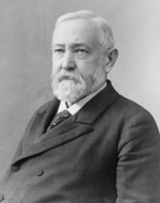
Benjamin Harrison was the 23rd President of the United States. His term ran from 1889 to 1893. He entered the White House after a close election and governed during rapid industrial growth. His presidency was marked by high tariffs, federal spending, civil service reform, and veterans’ policy. Benjamin Harrison also supported measures that expanded federal authority, while debates over money, labour and business shaped national politics.
Benjamin Harrison: Family and Education
Benjamin Harrison was born on 20 August 1833 in North Bend, Ohio. He came from a prominent political family. His grandfather, William Henry Harrison, had served as the ninth US President. His father, John Scott Harrison, later served in Congress.
He attended Miami University in Oxford, Ohio, and graduated in 1852. He then studied law in Cincinnati. After being admitted to the bar, he moved to Indianapolis, Indiana. There, he built a legal career and became active in public affairs.
His upbringing gave him strong political connections. Yet his career was developed through law, military service and Republican politics.
Administration Period
Benjamin Harrison became US President on 4 March 1889. His administration was shaped by a Republican majority in Congress. The White House became a centre of debates over economic policy and federal power.
The United States experienced strong economic activity during much of his term. The McKinley Tariff Act of 1890 raised tariff rates significantly. Supporters said protection would strengthen American industries. Critics argued that high tariffs increased prices and encouraged political favouritism.
The administration also supported the Sherman Antitrust Act of 1890. It was an early federal attempt to restrain business combinations that limited competition. Increased spending on pensions for Civil War veterans was also backed.
Political Career and Party
Before reaching office, he had built a substantial Republican career in Indiana. He served in the Senate from 1881 to 1887. Earlier, he had served as a Union officer during the American Civil War.
Harrison became the Republican presidential nominee in 1888. He defeated Democratic President Grover Cleveland in the Electoral College, although Cleveland received more popular votes. The result returned Republican control of the presidency.
As US President, Harrison was associated with the Republican Party’s protective tariff policy. He also supported federal legislation on elections. The Federal Elections Bill, often called the Lodge Bill, sought stronger federal oversight of congressional elections but failed to become law.
Predecessor and Successor in Office
His predecessor was Grover Cleveland. Harrison defeated Cleveland in the 1888 election and took office in 1889. The White House therefore changed from Democratic to Republican control.
Harrison’s administration ended in 1893. Grover Cleveland defeated him in the next presidential election. Cleveland then returned to the White House, becoming the first US President to serve two non-consecutive terms.
The political change reflected public concerns about tariffs, economic conditions and Republican policies. The United States was also entering a period of growing social and industrial tension.
Achievements and Legacy
He left a mixed but important presidential legacy. His administration strengthened federal action in several areas. The Sherman Antitrust Act established a lasting principle that the federal government could challenge certain restraints on trade.
His administration also admitted six states to the Union: North Dakota, South Dakota, Montana, Washington, Idaho and Wyoming. This expanded the political map of the United States and reflected continued western settlement.
The White House under Harrison also saw greater federal spending on veterans and pensions. His presidency showed how Republicans sought to use national power to support industry, veterans and federal institutions.
He remains important in the history of the US presidency. His one-term administration was shaped by economic expansion, party conflict and major legislation. The United States changed rapidly during his years in office. Federal power remained a stage for disputes that continued into the 1890s. His record remains significant for understanding how the US President and federal government responded to industrial and political change.
Leave a Reply