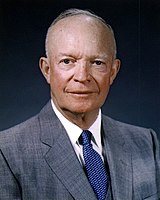
Dwight D. Eisenhower was a military commander and statesman whose leadership shaped the United States of America during a period of the 20th century. As US President, he was associated with economic growth, Cold War strategy and infrastructure development. His family background, education, achievements and challenges remain important to his legacy.
Family Background
He was born on 14 October 1890 in Denison, Texas, and was raised in Abilene, Kansas. He came from a large family with religious and working-class values. His parents, David Jacob Eisenhower and Ida Elizabeth Stover, were regarded as disciplined and principled people. The household emphasised education, hard work and responsibility.
His upbringing influenced the character later displayed by the US President. Family loyalty and personal discipline were regarded as essential qualities. These values were carried into military service and later public life in the United States of America.
Education and Military Training
He attended Abilene High School before entering the United States Military Academy at West Point in 1911. He graduated in 1915 and was trained in military leadership, strategy and organisation. His early military career was not marked by battlefield command, but valuable experience was gained.
His education prepared him for responsibilities. During the Second World War, his organisational skills were increasingly recognised. He was eventually appointed Supreme Allied Commander in Europe, where complex multinational operations were coordinated.
Parents and Children
Dwight D. Eisenhower married Mamie Geneva Doud in 1916. Their marriage lasted throughout his public career and was widely viewed as an important source of personal support. They had two sons, although their first child, Doud Dwight Eisenhower, died in infancy. Their surviving son, John Eisenhower, became a military officer, author and diplomat.
The family experience added a personal dimension to the public image of the US President. Mamie Eisenhower was also a prominent First Lady, and the family was frequently placed under public attention during his presidency in the United States of America.
Major Achievements
Dwight D. Eisenhower became Supreme Allied Commander during the Second World War and directed the Allied invasion of Normandy in 1944. His leadership was central to the successful coordination of forces from several nations. After the war, he served as Army Chief of Staff and later became the first Supreme Commander of NATO.
As US President from 1953 to 1961, he pursued containment against Soviet expansion while seeking to avoid unnecessary direct conflict. Major achievements included the Interstate Highway System, support for scientific development and the establishment of NASA. Economic stability was also pursued during much of his administration.
The United States of America was positioned as a major global power under his leadership. His presidency was marked by an emphasis on defence readiness, alliances and international diplomacy.
Challenges and Lasting Legacy
Dwight D. Eisenhower faced serious challenges during the Cold War. The threat of nuclear conflict required careful decisions, while tensions with the Soviet Union remained persistent. His administration also confronted racial segregation and the civil rights crisis. Federal troops were sent to enforce the desegregation of Central High School in Little Rock in 1957.
He also warned about the growing influence of the military-industrial complex. That warning became one of the most discussed parts of his political legacy. In America, his record has therefore been assessed through both military success and domestic controversy.
Dwight D. Eisenhower remains remembered as a leader whose military experience was converted into national and international influence. America benefited from major infrastructure expansion, while alliances and defence structures were strengthened. He also left a complex record on civil rights, nuclear policy and government spending. His career demonstrates how military leadership, public administration and presidential responsibility can shape the United States of America. His example remains significant in understanding a US President’s responsibilities.
Leave a Reply