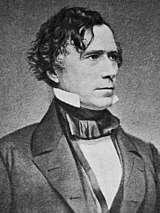
Franklin Pierce, the 14th President of the United States, served from 1853 to 1857 during one of the most turbulent periods leading up to the American Civil War. His presidency is often remembered for its controversies surrounding slavery and sectional divisions, yet his early life and political rise reveal a man of intellect, ambition, and deep patriotic commitment.
Early Life and Background
Franklin Pierce was born on November 23, 1804, in Hillsborough, New Hampshire, into a prominent political family. His father, Benjamin Pierce, was a Revolutionary War hero and twice served as Governor of New Hampshire. Growing up in a family deeply engaged in public affairs, Franklin was naturally drawn to politics and civic service from an early age.
Education and Early Career
Pierce attended Bowdoin College in Maine, where he studied alongside future influential figures such as Nathaniel Hawthorne, who later became a lifelong friend. After graduating in 1824, he pursued a career in law and was admitted to the bar in 1827. His eloquence, charisma, and strong oratory skills quickly earned him a reputation in New Hampshire’s political circles.
Political Rise
At just 24 years old, Pierce entered politics, first serving in the New Hampshire legislature and later becoming Speaker of the House. His leadership and alignment with Democratic Party ideals propelled him to the U.S. House of Representatives in 1833 and later to the U.S. Senate in 1837. However, he resigned from the Senate in 1842 to focus on his family and legal practice, demonstrating a desire for balance between public duty and private life.
Military Service
During the Mexican-American War (1846–1848), Pierce volunteered for military service and was appointed a brigadier general. His performance in the war, despite suffering an injury, bolstered his public image and reinforced his national credibility as a patriotic leader.
Presidency (1853–1857)
Franklin Pierce assumed the presidency on March 4, 1853, as a Democrat and the youngest president at that time (48 years old). His presidency was marked by efforts to maintain unity between the North and South amidst escalating tensions over slavery.
One of his major domestic challenges was the Kansas-Nebraska Act of 1854, which allowed settlers in those territories to decide for themselves whether to permit slavery. This policy, intended to ease tensions, instead deepened national division, sparking violent clashes known as “Bleeding Kansas” and leading to the collapse of the Whig Party and the rise of the Republican Party.
On the foreign front, Pierce’s administration is credited with the Gadsden Purchase (1854), which acquired territory from Mexico (present-day southern Arizona and New Mexico). This expansion completed the continental boundaries of the United States and facilitated plans for a southern transcontinental railroad.
Other Political Factors
Pierce was a staunch supporter of the concept of “Manifest Destiny” – the belief that America was destined to expand across the continent. However, his pro-Southern sympathies and enforcement of the Fugitive Slave Act alienated Northern abolitionists, severely damaging his political support. By the end of his term, his popularity had plummeted, and his party refused to renominate him for a second term.
Later Years and Legacy
After leaving office in 1857, Pierce retired to New Hampshire, where he lived a relatively quiet life, remaining outspoken against the Civil War and advocating for national reconciliation. His opposition to President Lincoln’s wartime policies further isolated him politically. Franklin Pierce died on October 8, 1869, in Concord, New Hampshire, at the age of 64.
Franklin Pierce’s presidency remains one of the most debated in American history. While he achieved notable territorial expansion and sought to preserve the Union, his inability to address the growing sectional crisis over slavery effectively contributed to the nation’s slide toward civil war. Nevertheless, his life reflects the complexity of 19th-century American politics, a mix of ambition, patriotism, and the painful realities of a divided nation.
Leave a Reply