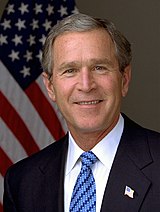
George Walker Bush, the 43rd President of the United States, served two terms from 2001 to 2009. His presidency was defined by the September 11 terrorist attacks, the ensuing “War on Terror,” and significant domestic policies that shaped America’s political and economic landscape in the early 21st century. A leader with deep personal faith and strong convictions, Bush’s time in office remains one of the most consequential and debated periods in modern American history.
Early Life and Background
George W. Bush was born on July 6, 1946, in New Haven, Connecticut, into one of the most prominent political families in the United States. His father, George H. W. Bush, served as the 41st President, and his grandfather, Prescott Bush, was a U.S. Senator. Growing up primarily in Texas, Bush was raised with strong values of public service, responsibility, and faith.
Bush’s early life was marked by both privilege and personal challenges. Known for his outgoing personality and sense of humor, he developed an interest in sports, especially baseball, which remained a lifelong passion.
Education and Early Career
Bush attended Yale University, graduating in 1968 with a degree in history. Afterward, he joined the Texas Air National Guard, where he trained as a pilot during the Vietnam War era. In 1975, he earned an MBA from Harvard Business School, making him the first U.S. president to hold an MBA degree.
Following his studies, Bush entered the oil business in Texas, establishing several energy companies. His ventures met with mixed success, but they helped him build strong business and political connections that would later support his public career.
Political Rise
Bush’s political journey began in earnest in the 1980s when he helped manage his father’s successful 1988 presidential campaign. His own political breakthrough came in 1994, when he was elected Governor of Texas after defeating incumbent Ann Richards. As governor, Bush focused on education reform, tax cuts, and bipartisanship, earning a reputation as a “compassionate conservative.” His popularity and leadership in Texas positioned him as a strong Republican candidate for the presidency in 2000.
Presidency (2001–2009)
George W. Bush assumed office on January 20, 2001, after one of the most contentious elections in U.S. history, which was ultimately decided by the Supreme Court in Bush v. Gore. His presidency was quickly reshaped by the September 11, 2001 terrorist attacks, a defining moment that transformed U.S. domestic and foreign policy.
In response, Bush launched the War on Terror, leading U.S. military operations in Afghanistan to dismantle al-Qaeda and remove the Taliban regime. In 2003, his administration initiated the Iraq War, citing the need to eliminate weapons of mass destruction and promote democracy, a move that sparked global controversy and lasting debate.
Domestically, Bush established the Department of Homeland Security and signed the USA PATRIOT Act, both aimed at strengthening national security. His “Bush Doctrine” emphasized preemptive action against threats, reshaping America’s global stance.
Major Achievements and Domestic Policies
Despite foreign policy controversies, Bush achieved several notable domestic reforms:
- Education: Enacted the No Child Left Behind Act (2002), focusing on accountability and standardized testing to improve public education.
- Medicare Reform: Signed the Medicare Prescription Drug, Improvement, and Modernization Act (2003), expanding healthcare coverage for seniors.
- Tax Policy: Implemented significant tax cuts in 2001 and 2003, aiming to stimulate economic growth.
- Faith-Based Initiatives: Promoted partnerships between government and religious organizations to address social issues.
However, his second term was challenged by natural disasters and economic instability. The Hurricane Katrina disaster in 2005 drew criticism over the government’s slow response, while the 2008 global financial crisis deeply affected his administration’s legacy.
Other Political Factors
Bush’s leadership style was often described as decisive and values-driven, though critics accused him of unilateralism in foreign policy and expanding executive power. His approval ratings soared after 9/11 but declined during the Iraq War and economic downturn. Nonetheless, his commitment to democracy promotion and global security shaped international politics for decades.
Later Years and Legacy
After leaving office in 2009, Bush retired to Texas, focusing on philanthropy, veterans’ causes, and painting. He established the George W. Bush Presidential Center in Dallas, housing his library, museum, and policy institute.
Public opinion of Bush’s presidency has softened over time, with many viewing him as a principled leader who faced unprecedented challenges. His humanitarian work and calls for national unity have earned renewed respect across party lines.
Conclusion
George W. Bush’s presidency was a pivotal chapter in U.S. history. Confronted by terrorism, war, and economic crisis, he led with conviction and faith in American ideals. While his decisions remain subjects of debate, his impact on national security, education reform, and global diplomacy continues to influence the United States’ role in the world today.
Leave a Reply