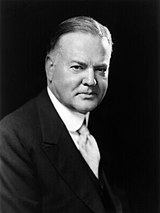
Herbert Clark Hoover was the 31st President of the United States and served from 1929 to 1933. Herbert Clark Hoover entered the White House with a strong reputation as an engineer, businessman and humanitarian. His presidency, however, was dominated by the Great Depression. The crisis tested the United States and shaped how the White House responded to widespread unemployment, poverty and economic hardship. Herbert Clark Hoover remains an important figure in the history of the US presidency.
Family & Education
Herbert Clark Hoover was born on 10 August 1874 in West Branch, Iowa. He came from a Quaker family. His father, Jesse Clark Hoover, was a blacksmith and agricultural implement dealer. His mother, Hulda Randall Minthorn Hoover, was deeply involved in religious and community activities.
Hoover was orphaned at a young age. He was raised by relatives after the death of both parents. His education later took him to Stanford University. He studied geology and graduated in 1895.
His professional career was built around mining and engineering. He travelled extensively and worked in several countries. His international experience helped establish him as a successful mining consultant. Before entering politics, he had accumulated considerable wealth and professional influence.
Administration Period
Herbert Clark Hoover became president on 4 March 1929. His administration began during a period of economic optimism. Months later, the Wall Street Crash occurred.
The resulting Great Depression became the defining challenge of his presidency. Businesses collapsed. Banks failed. Unemployment increased sharply. Many families struggled to afford basic necessities.
The White House sought measures to support economic recovery. Hoover supported public works and encouraged cooperation between government and businesses. The Reconstruction Finance Corporation was also established to provide financial assistance to banks and other institutions.
However, many Americans believed that the response was insufficient. The United States economy continued to suffer. The administration was criticised for relying heavily on voluntary cooperation rather than direct federal relief.
Political Party
Herbert Clark Hoover was a member of the Republican Party. He won the 1928 presidential election as the Republican candidate. His victory reflected the political strength enjoyed by Republicans during the 1920s.
As US President, Hoover continued several Republican economic policies. Limited government intervention remained an important principle. However, the economic emergency forced his administration to expand federal involvement.
The White House introduced measures that represented a greater federal role than Hoover’s political philosophy had initially suggested. His administration also supported major infrastructure projects.
Hoover’s political reputation suffered as the depression deepened. In 1932, he lost the presidential election to Democrat Franklin D. Roosevelt. The result marked a major political change in the United States.
His Predecessor and Successor in Office
Herbert Clark Hoover succeeded Calvin Coolidge as US President. Coolidge had served as president from 1923 to 1929. Hoover inherited an economy that appeared strong but contained weaknesses that became more visible after the 1929 crash.
Franklin D. Roosevelt succeeded Hoover in 1933. Roosevelt’s administration introduced the New Deal, bringing a much larger federal response to the economic crisis.
The transfer of power at the White House represented a significant turning point. The United States entered a new era of federal economic intervention.
Achievements & Legacy
Herbert Clark Hoover’s achievements included major public works and institutional reforms. The Hoover Dam became one of the most notable projects associated with his era. His administration also supported the Reconstruction Finance Corporation and other efforts aimed at stabilising the economy.
His earlier humanitarian work also remains important. Before becoming president, Hoover helped organise large-scale food relief during and after the First World War. His reputation as a humanitarian had been established long before entering the White House.
Herbert Clark Hoover’s legacy is closely connected to the Great Depression. His critics argued that his policies failed to provide adequate relief. Supporters, however, point to the measures adopted as evidence that he did respond to the crisis.
The United States remembers Hoover as a president whose administration faced extraordinary economic conditions. Herbert Clark Hoover entered office during prosperity but left amid severe hardship. His presidency demonstrates how rapidly national circumstances can change and how strongly an economic crisis can shape a US President’s historical reputation. The White House response during his administration continues to be examined when assessing the changing role of government in the United States.
Leave a Reply