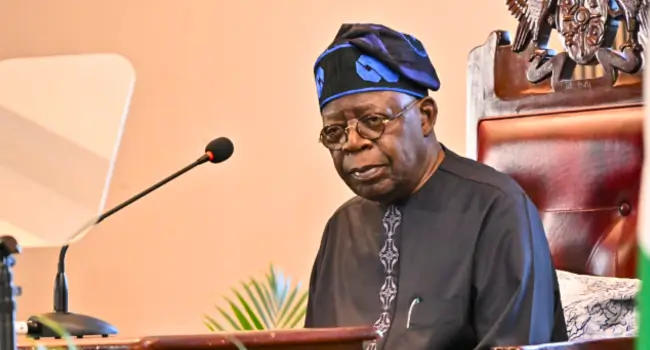
President Bola Tinubu’s declaration of a national security emergency on November 27, along with the directive for large-scale recruitment into the police and armed forces, has been widely interpreted as a bold attempt to confront Nigeria’s deepening insecurity. Yet, beneath the urgency of the moment lies a fundamental flaw: treating the crisis as a shortage of manpower rather than a breakdown of institutional integrity and a widening ideological war. While more boots on the ground may appear to be a quick fix, the realities of Nigeria’s security landscape demand a deeper, more strategic recalibration.
At the heart of the insecurity challenge is a military and law-enforcement system plagued by institutional compromise. This goes far beyond operational lapses. Evidence increasingly shows infiltration, sabotage, and intelligence leaks from within the security architecture itself. Incidents such as the orchestrated capture of Brigadier General Musa Ubah or the puzzling withdrawal of personnel during the Kebbi school abduction reflect not isolated missteps, but a recurring pattern of internal compromise. These events point to the existence of a “fifth column”- individuals within the system who aid non-state actors, undermine operations, or deliberately expose troops to ambush. Under these conditions, expanding the force without first cleansing it risks multiplying the very vulnerabilities that have weakened national security.
Equally troubling is the rapid decline in the military’s public prestige and institutional legitimacy. Once revered, the uniform has lost much of the honour it once commanded. Today, many families discourage their children from enlisting, and public morale toward the armed forces has noticeably eroded. This crisis of legitimacy has direct implications: it shrinks the pool of patriotic, motivated recruits and heightens the danger of enrolling individuals who may be ideologically ambivalent, or worse, sympathetic to insurgent or criminal networks. Nigeria’s security problem is not merely a contest of arms; it is a contest of ideology, loyalty, and public trust. Recruiting tens of thousands under current conditions risks embedding hostile ideologies within the very institution meant to neutralise them.
Moreover, the scale of insurgency and banditry in Nigeria reveals a deeper socio-political and ideological dimension. With an estimated 30,000 armed non-state actors supported by intricate local and external networks, the challenge is not one that sheer numbers alone can resolve. Nigeria’s persistent intelligence failures are indicative of more than technical shortcomings, they reveal pockets of community alignment, silent approval, or passive complicity with anti-state forces. The freedom with which bandits and militants operate across vast territories suggests not just fear but a broader crisis of societal trust and state legitimacy. In such a context, a purely militaristic response is inadequate.
Therefore, the first strategic step must be the suspension of mass recruitment until a comprehensive internal audit and forensic vetting of existing personnel is completed. Military intelligence should conduct deep investigations, especially into cases where ambush survivors present suspicious patterns. Rebuilding confidence also requires transparency. Public trials for personnel found guilty of collusion or treason would demonstrate accountability, restore faith in the system, and deter future acts of betrayal.
Beyond institutional reform, Nigeria must launch a sophisticated Strategic Communication (StratCom) offensive. This ideological campaign should aim to dismantle the narratives that sustain insurgent groups and cut them off from community support. Just as the Vietnam War was shaped by the battle for public perception, Nigeria must leverage media to expose the human and economic costs of banditry, discredit militants as economic destroyers, and rally communities against them. The goal is to make collaboration with insurgents socially unacceptable, morally condemned, and publicly resisted.
President Tinubu’s security emergency acknowledges the gravity of Nigeria’s crisis, but a reflexive recruitment surge may ultimately worsen institutional decay. A wiser path is a temporary pause on expansion, a relentless clean-up of the security agencies, and an aggressive ideological counteroffensive. Nigeria’s future will not be secured by sheer numbers, but by restoring integrity to its security institutions and winning the war of ideas that fuels the conflict.
Leave a Reply