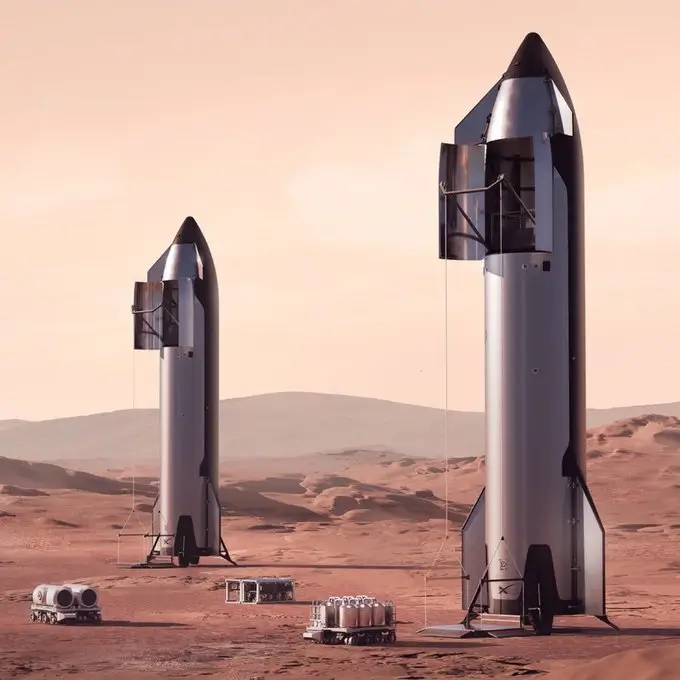
Imagine this: In the vast, crimson dunes of Mars, the first human footsteps not just as a fleeting visit, but as the dawn of a new civilization. That’s the vision Elon Musk has been relentlessly pursuing since founding SpaceX in 2002. Not content with orbiting Earth or returning to the Moon, Musk’s ultimate goal is to transform humanity into a multiplanetary species – ensuring our survival against existential threats like asteroids, pandemics, or self-inflicted disasters.
“The fundamental question is whether Earth civilization can maintain its technology level long enough for the colony to grow on its own,” Musk tweeted in July 2024. Fast-forward to November 2025: With Starship’s rapid evolution, this sci-fi dream is inching closer to reality. Buckle up – here’s the full, unfiltered breakdown of Musk’s Mars mission, from tech breakthroughs to bold timelines and the hurdles ahead.
The Vision: Why Mars? Why Now?
Musk isn’t just building rockets; he’s engineering humanity’s backup plan. He argues that relying on a single planet is a cosmic gamble – “all our eggs in one basket,” as he puts it. Mars, with its thin CO2 atmosphere, polar ice caps, and potential for subsurface water, offers the best shot at a self-sustaining outpost. The endgame? A city of 1 million+ people by the 2040s, complete with dome habitats, solar farms, and in-situ resource utilization (ISRU) to produce oxygen, fuel, and food from Martian regolith.
This isn’t NASA’s cautious, government-funded crawl. SpaceX is self-funding over 90% of development, leveraging profits from Starlink (now beaming internet to remote disaster zones for free during crises). Musk’s mantra: “Even if we fail at creating a Mars colony… the absurdly ambitious nature of the goal nonetheless results in alien-level technology.” It’s a high-stakes bet that’s already revolutionized reusable rocketry.
The Starship: A Beast Built for the Red Planet
At the heart is Starship, the world’s most powerful rocket – a 120-meter stainless-steel colossus powered by 33 methane-fueled Raptor engines on its Super Heavy booster. Fully reusable (booster catches and ship landings), it can haul 100+ tons to Mars per flight, dwarfing NASA’s SLS (27 tons to orbit) or Apollo’s Saturn V.
Key specs that make it Mars-ready:
- Payload Magic: Up to 150 tons to low Earth orbit (LEO), scaling to 100 tons to Mars surface after refueling.
- Crew Capacity: 100+ passengers in a pressurized volume exceeding 1,000 m³ – bigger than the ISS! Think multi-deck living quarters, life support, and even Cybertruck parking for surface ops.
- Propellant Trick: In-orbit refueling via “tanker” Starships – up to 16 flights per mission to fill its 1,200-ton methane/oxygen tanks.
- Landing Tech: Heat shield tiles for Mars’ thin atmosphere entry, plus retro-propulsion for pinpoint touchdowns.
Musk calls it the “first planet-colonizer class rocket.” No AI was used in its design yet – “pretty good for a bunch of monkeys,” he quipped. But xAI’s Grok could supercharge future iterations, etching knowledge libraries on oxide plates for Mars’ “Encyclopedia Galactica.”
The Roadmap: From Earth Orbit to Martian Domes
Musk’s timelines are aggressive, evolving with test data. Here’s the 2025 update from his May 29 Starbase presentation: “The Road to Making Life Multiplanetary.”
| Phase | Timeline | Key Milestones | Details |
|---|---|---|---|
| Uncrewed Pioneers | Late 2026 (50% chance) | 5 Starships launch in Nov-Dec window | Test intact landings; carry Tesla Optimus robots to scout sites, build solar arrays, and prep ISRU plants. If missed, next window: 2028. |
| Crewed Landings | 2029 (optimistic) or 2031 (likely) | First humans touch down | 20 ships in 2028-29 window; focus on habitat construction at Arcadia Planitia (flat, resource-rich site). |
| Fleet Expansion | 2030-33 | 100+ ships per window | Ramp to 500 missions by 2033; deliver 1M tons cargo for self-sufficiency. |
| Self-Sustaining City | 2040s | 1M+ population | Domes, hydroponics, 3D-printed habitats; “Occupy Mars” – direct democracy, no kings. |
Travel time? 6-9 months during optimal Earth-Mars alignments (every 26 months). Cost per ticket: Musk aims for $100K – $1M eventually, like historical sea voyages – risky, but an “epic adventure.”
Tech Hurdles: The Devil in the Details
It’s not all smooth sailing. 2025 saw Starship explosions during tests (January, March, May), but each “rapid unscheduled disassembly” yields data. FAA approvals now allow 25 flights/year. Bigger challenges:
- Refueling: Never demo’d at scale; critical for Mars transit.
- Radiation & Life Support: Cosmic rays demand shielding; closed-loop systems for air/water/food.
- Surface Ops: Optimus bots for grunt work, but critics like Robert Zubrin argue for more rovers/helicopters over humanoid reliance. (Musk: “Starship could deliver an army of them – Normandy Beach style.”)
- Ethics/Science: Planetary protection – avoid contaminating potential Martian life. Zubrin calls for NASA-SpaceX coalitions for co-exploration.
Competition heats up: China’s Zhuque-3 (stainless steel, methalox) eyes Falcon-beating reusability, but Musk scoffs – “Starship in another league.” SpaceX dominates 83% of global payload to orbit in 2025.
The Bigger Picture: Legacy of a Mad Genius
Musk’s Mars push ties into his empire: Starlink funds it (300GW/year solar AI sats possible via Starship), Tesla’s Optimus scouts ahead, xAI preserves knowledge. Critics call it billionaire vanity; fans see salvation. As Musk said, “SpaceX will colonize Mars… to pass the single-planet Fermi Great Filter.”
We’re on the cusp. If Starship nails 2026 landings, 2029 could see boots on red soil. Failure? Still, reusable tech cascades to Earth (cheaper sats, lunar bases). Multiplanetary life isn’t just survival – it’s evolution.
Leave a Reply