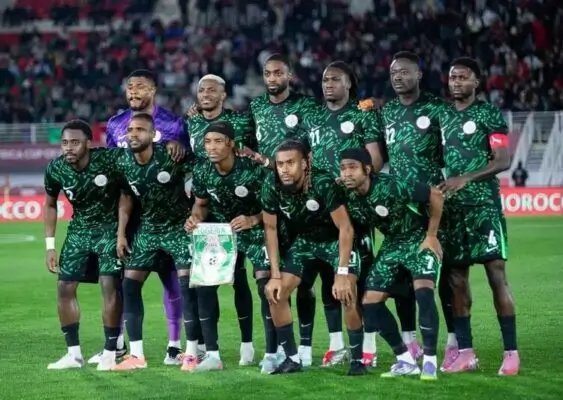
Hope for Super Eagles as the Nigeria Football Federation (NFF) has moved to steady national optimism by reaffirming that Nigeria’s dream of qualifying for the 2026 FIFA World Cup remains alive, despite recent disappointments. At the centre of this renewed hope is a formal complaint lodged with FIFA over the eligibility of several Democratic Republic of Congo (DR Congo) players who featured in a decisive play-off match. For Nigerian football followers, the development has reopened conversations about resilience, procedure, and the thin margins that often define global qualification campaigns, especially for the Super Eagles.
Nigeria’s journey toward the expanded 48-team World Cup suffered a major blow in November 2025, when DR Congo edged past the Super Eagles via penalties to secure Africa’s slot in the Intercontinental Play-Offs. The loss was painful, not just because of its timing, but because it appeared to shut the door on Nigeria’s immediate qualification hopes. For a nation with a strong World Cup pedigree, the defeat raised serious questions about performance, preparation, and fortune, leaving the Super Eagles on the brink of missing out on football’s biggest stage.
However, the narrative has shifted following reports that DR Congo may have fielded ineligible players during the play-off final. According to emerging claims, up to six players who had switched national allegiance allegedly failed to complete mandatory documentation required under FIFA rules. These regulations demand that players formally renounce previous national associations before representing a new country. If the allegations are upheld, it could dramatically alter the outcome of the match that halted the Super Eagles’ progress.
Hope for Super Eagles
Under FIFA statutes, nationality switches are treated with strict scrutiny to preserve fairness and integrity in international competitions. Any failure to comply with eligibility procedures can result in sanctions, including forfeiture of matches. This framework has provided the basis for Nigeria’s case, with the NFF arguing that procedural lapses may have unfairly disadvantaged the Super Eagles at a critical moment in the qualification race.
In response to the reports, the NFF acted swiftly by submitting a formal petition to FIFA. The federation is challenging DR Congo’s use of the disputed players and is seeking appropriate sanctions that could potentially overturn the play-off result. According to officials, the decision to escalate the matter was taken after careful legal and regulatory review, reflecting confidence that the complaint is not speculative but grounded in established rules that protect teams like the Super Eagles from irregular competition practices.
NFF General Secretary, Dr Mohammed Sanusi, has publicly expressed confidence in Nigeria’s position. Speaking during a radio interview, he stressed that the federation would not pursue a case without substance. His comments suggest that the NFF believes there is sufficient evidence to warrant FIFA’s intervention, a stance that has boosted belief among supporters of the Super Eagles that justice may still tilt in their favour.
Should FIFA rule against DR Congo, the implications would be significant. Nigeria would be reinstated into the qualification pathway, allowing the Super Eagles to advance to the six-team Intercontinental Play-Off scheduled for March. This mini-tournament is designed to determine the final two slots for the 2026 World Cup, offering teams a final, high-stakes opportunity to qualify.
2026 World Cup Play-Off
For the Super Eagles, participation in the Intercontinental Play-Off would represent both redemption and renewed pressure. It would provide a late chance to reclaim momentum, test squad depth, and reaffirm Nigeria’s standing on the global stage. Success would mark a seventh World Cup appearance, reinforcing the team’s legacy and restoring confidence after a turbulent qualification cycle.
Ultimately, while FIFA’s ruling remains pending, the situation underscores the importance of governance and compliance in modern football. For Nigerian fans, the message from the NFF is clear: the door is not yet closed. As events unfold, the Super Eagles stand at the intersection of hope and procedure, waiting to see whether regulation and resolve can yet carry them back to the world’s biggest football festival.
Leave a Reply