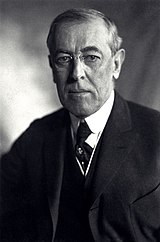
Woodrow Wilson was the 28th President of the United States. His presidency shaped American politics at home and abroad. A former academic and governor, he entered the White House with a reform agenda. He later led the United States of America through the First World War. His administration introduced major domestic reforms. It also faced intense political and racial controversies. Woodrow Wilson remains an important figure in the history of the US President office.
Woodrow Wilson: Family and Education
Woodrow Wilson was born Thomas Woodrow Wilson on 28 December 1856 in Staunton, Virginia. His father, Joseph Ruggles Wilson, was a Presbyterian minister and professor. His mother was Janet Woodrow. His family placed strong emphasis on education and religion.
Wilson studied at the College of New Jersey, now Princeton University. He graduated in 1879. He later studied law at the University of Virginia. He eventually earned a doctorate in political science and history from Johns Hopkins University.
His academic career developed steadily. He taught at several institutions. He became president of Princeton University in 1902. His time in academia helped shape his views on government and public administration.
Administration and White House Years
Woodrow Wilson became US President in March 1913. His first administration focused on economic and political reform. The Federal Reserve Act was passed in 1913. It created the Federal Reserve System and changed the country’s banking structure.
The White House also supported the Clayton Antitrust Act. The Federal Trade Commission was established during his presidency. These measures strengthened federal regulation of business.
Woodrow Wilson won re-election in 1916. His campaign promoted neutrality in the European conflict. However, the United States of America eventually entered the First World War in 1917.
The White House became a centre of wartime decision-making. Wilson presented his Fourteen Points as a framework for peace. His administration also supported the creation of the League of Nations.
Political Career Before the Presidency
Woodrow Wilson entered national politics after years in education. He was elected governor of New Jersey in 1910. His reform record quickly attracted national attention.
As governor, he challenged aspects of political machine control. He supported reforms involving elections, public utilities and government administration. His record helped establish him as a leading Democratic figure.
In 1912, Wilson secured the Democratic presidential nomination. The Republican vote was divided between William Howard Taft and Theodore Roosevelt. Wilson won the election and became US President.
His political career demonstrated a transition from academic leadership to national executive power. He used his experience in government reform to shape his administration.
First World War and International Leadership
The outbreak of war in Europe tested Woodrow Wilson’s leadership. He initially sought neutrality. The United States of America remained outside the conflict for several years.
German submarine warfare changed the situation. In April 1917, Congress declared war on Germany after Wilson requested military action. The US President then became a central figure in the Allied war effort.
The White House organised mobilisation on a large scale. American troops and resources contributed to the eventual Allied victory. Wilson then travelled to Europe for the peace negotiations.
His international vision was ambitious. He wanted a new system based on collective security. The League of Nations became central to that plan. However, the US Senate rejected American membership.
Predecessor and Successor
Woodrow Wilson succeeded William Howard Taft as US President in 1913. Taft had served from 1909 to 1913. Wilson’s victory marked a Democratic return to the White House after two Republican administrations.
Wilson’s presidency ended in March 1921. Warren G. Harding became his successor. Harding campaigned for a return to what he described as normalcy after war and political conflict.
Woodrow Wilson left office after suffering serious health problems. His final years were marked by declining physical capacity. His administration nevertheless had lasting effects on American government and foreign policy.
The United States of America continued to debate his legacy. Supporters highlighted his reforms and international vision. Critics pointed to racial segregation in the federal government and his administration’s limitations on civil liberties.
Woodrow Wilson remains a complex historical figure. His presidency expanded federal economic regulation and placed the White House at the centre of global diplomacy. As US President, he transformed the role of the office during a period of extraordinary international change. His decisions helped define how the United States of America approached both domestic reform and world affairs.
Leave a Reply