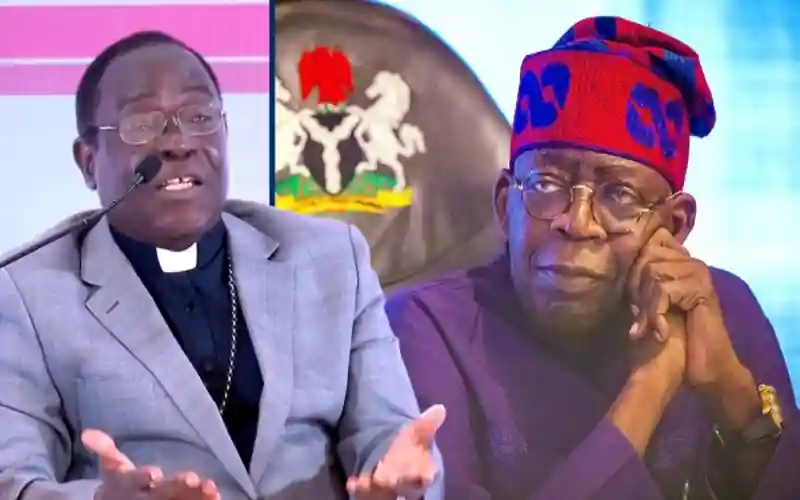
Matthew Kukah, the Catholic Archbishop of Sokoto Diocese has slammed Nigeria’s leaders for lack of preparedness before venturing into political to leadership.
Bishop Kukah made statement during the keynote address delivered at the official commissioning of Start-Rite School’s new building and the 4th Amaka Ndoma-Egba Memorial Lecture in Abuja. He sharply criticize the leadership trajectory of Nigeria’s past and present presidents.
According to Kukah, leaders, including President Bola Tinubu, have often found themselves in power by chance, rather than through careful preparation or clear vision. Kukah emphasized that Nigeria’s leadership crisis isn’t simply a matter of politics, but of a deeper, systemic issue in the country’s approach to governance. He argued that the absence of knowledge and preparation among Nigerian leaders is a fundamental problem that continues to undermine effective leadership.
Kukah traced the history of Nigerian leadership, pointing out that most leaders did not ascend to power by design or intent but were instead thrust into leadership due to unforeseen circumstances. He noted that President Bola Tinubu, despite claiming to be prepared for the presidency, is struggling to meet the expectations of the office. This, according to Kukah, is indicative of a broader trend where leaders have been unprepared for the enormous challenges that come with the role.
He reflected on how previous leaders, including Tinubu’s predecessor, Muhammadu Buhari, and even Buhari’s predecessors, rose to power by accident. “If we are to start from the beginning, you will find that almost every leader who came to power in Nigeria did so as a result of one accident or another,” Kukah stated.
He pointed to Buhari’s transition from military to civilian rule, Jonathan’s unexpected rise from deputy governor to president, and the unforeseen death of President Yar’Adua, which handed power to Goodluck Jonathan.
Even further back, General Olusegun Obasanjo’s release from prison to assume leadership following the death of General Sani Abacha highlights how contingency, not preparation, has often shaped Nigerian leadership.
Knowledge in Leadership
Kukah’s most critical observation was the glaring lack of knowledge among those who lead Nigeria. He expressed deep concern that many Nigerian leaders lack a profound understanding of their country, its people, and its complex challenges. “The fundamental issue in governance is knowledge.
Leaders need a deep understanding of their environment,” Kukah emphasized.He believes this knowledge gap has resulted in failed policies and ineffective governance, making it difficult for the country to progress or fully harness its potential. Leaders, Kukah argued, must be grounded in a comprehensive understanding of Nigeria’s socio-political landscape if they are to bring about meaningful change.
The Malfunction of Democracy
Kukah further pointed out that democracy in Nigeria is malfunctioning, suggesting that the expectations of leadership have not evolved in line with the changing world. Despite Nigeria’s claims of being a democratic nation, Kukah argues that successive administrations have struggled to meet the demands of modern governance.
This has resulted in disillusionment among citizens, who continue to see democracy as an incomplete and dysfunctional system.
As Kukah put it, while the world has changed rapidly, Nigerian leadership has remained stagnant, failing to adapt to contemporary governance standards or provide a vision that aligns with global progress.
For Kukah, the solution to Nigeria’s governance challenges lies in leadership that is both well-prepared and knowledgeable. The country’s leaders must not only be skilled in political maneuvering but must also possess a deep, nuanced understanding of the nation’s social, economic, and cultural dynamics.
Kukah’s remarks serve as a call to action for Nigerian leaders at all levels to focus on education, preparation, and an ongoing commitment to understanding the people they serve.
Without these elements, Kukah warns, Nigeria’s democratic system will continue to malfunction, and the cycle of accidental leadership will persist. The fundamental question Kukah raises is clear: How can Nigeria move forward when its leaders, by their own admission, were never truly prepared to govern? #Politics
Leave a Reply