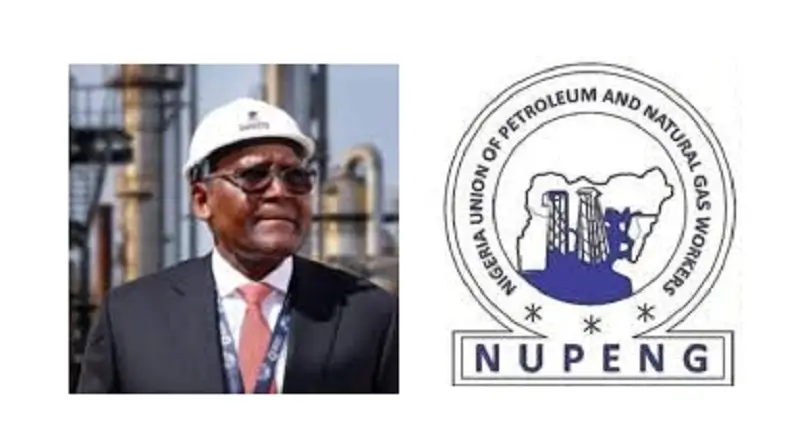
The high-level meeting convened by the Federal Government to resolve the ongoing labour dispute between the Dangote Group and the Nigeria Union of Petroleum and Natural Gas Workers (NUPENG) ended without resolution, deepening concerns over potential disruptions in the nation’s petroleum sector.
The talks, chaired by Minister of Labour and Employment, Muhammad Maigari Dingyadi, sought to address long-standing tensions over workers’ rights to unionise at the Dangote Refinery and allied facilities. However, disagreements over the drafting of a Memorandum of Understanding (MoU) led to repeated walkouts, leaving the matter unresolved.
Deadlock Over Union Rights
While Dangote Group reportedly accepted in principle that its refinery and petrochemical staff could join NUPENG, labour representatives objected to what they described as “offensive clauses” inserted into the draft MoU, which they feared could be used to undermine workers during future strikes.
The disagreement forced NUPENG, supported by Nigeria Labour Congress (NLC) representatives, to suspend participation twice. At one point, Dangote representatives were also said to have exited the meeting in protest.
Solidarity From PENGASSAN and Labour Coalitions
The Petroleum and Natural Gas Senior Staff Association of Nigeria (PENGASSAN) declared “unwavering solidarity” with NUPENG, warning that it was prepared to join the strike if the Dangote Group continued to resist unionisation. In a statement, PENGASSAN emphasised that denying workers the right to organise was a violation of Nigerian labour laws and international conventions.
Similarly, the African Regional Organisation of the International Trade Union Confederation (ITUC-Africa) condemned what it described as Dangote’s “persistent anti-union practices.” From its headquarters in Lomé, Togo, the body warned that it was on “red alert” for continent-wide mobilisation if the company failed to comply with international labour standards.
Federal Government Appeals for Compromise
With tensions mounting, the Ministry of Labour has urged all parties to return to dialogue, stressing that a prolonged impasse could destabilise industrial peace in the petroleum sector and beyond. “This matter is of critical importance to Nigeria’s stability and economic wellbeing,” one senior official noted.
What Lies Ahead
As the strike threat looms, stakeholders warn of significant economic risks should refinery operations be disrupted. Labour leaders have insisted that unless workers’ rights to freely unionise are respected, they will escalate industrial action in coordination with national and international allies.
The unfolding standoff now places pressure on the Federal Government to broker a durable resolution that balances corporate interests with workers’ constitutional and international labour rights.
Leave a Reply